What is Qi2, and Why Should Australian Venue Operators Care?
Qi2 made wireless charging reliable, and Qi2.2 made it fast enough for a seated patron to see it work. What the standard means for an Australian venue, and how to spec it.
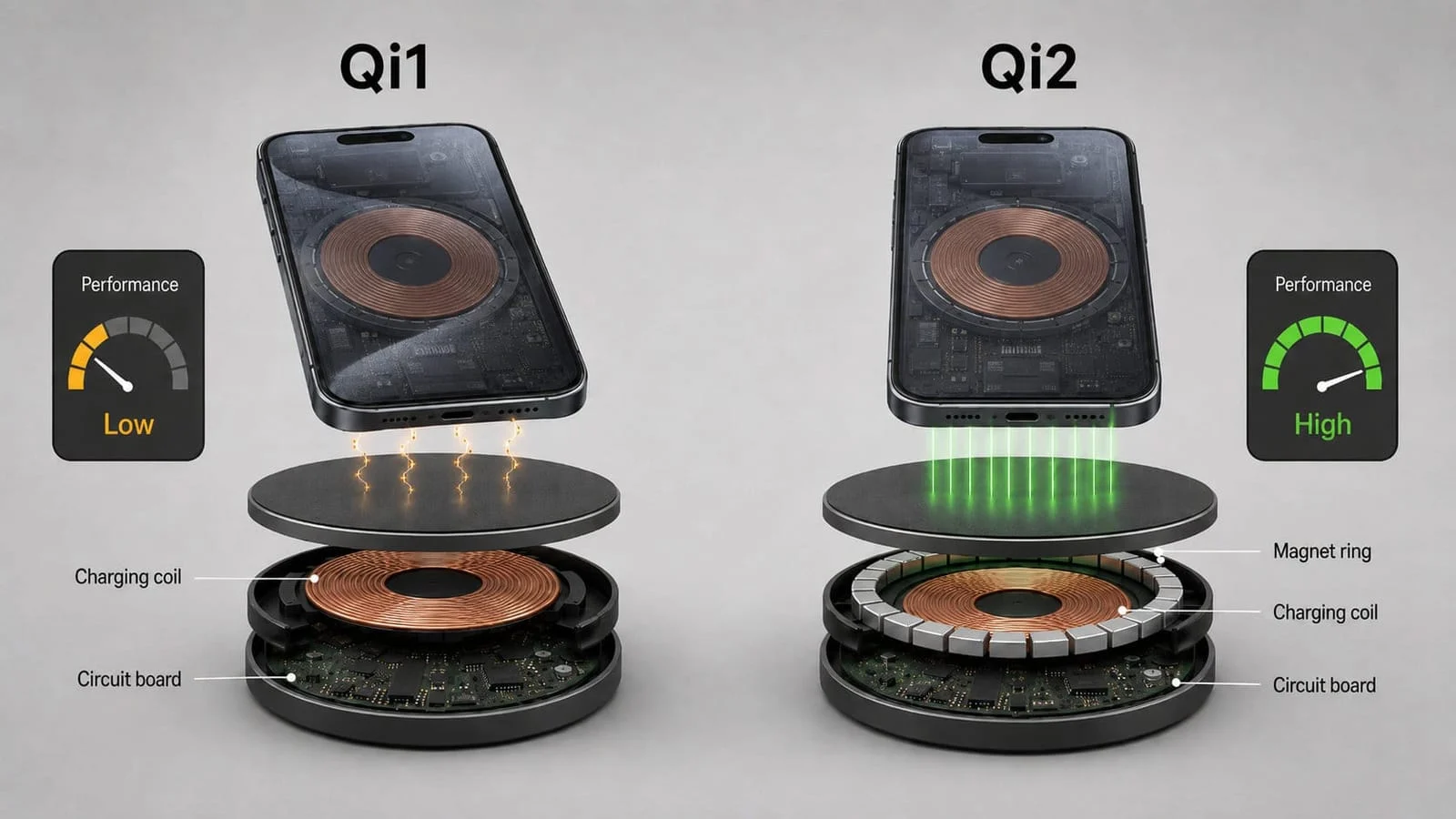
The short version: Qi2 made wireless charging reliable by adding magnetic alignment, so the phone snaps into the right spot every time. Qi2.2 makes it fast, raising the standard to 25W, which is the point where a patron sees their phone charging while they sit. For a venue, that speed is the difference between an amenity people trust and one they quietly write off.
- Qi2 fixed alignment (the phone snaps into place). Qi2.2 fixes speed (up to 25W).
- 25W is the behavioural threshold: a phone goes from 20% to 70% in about 33 minutes, fast enough to notice in a single visit.
- Old 5 to 7.5W pads barely move a battery, which is why “we tried wireless charging and it didn’t work” almost always comes down to the hardware tier.
- Stay Charged’s current units (SwiftPro 25W, ChargeHUB 25W) are built to the Qi2.2 standard, RCM marked and AS/NZS compliant.
- What to check when speccing: 25W (Qi 2.2 MPP), Australian compliance marks, the right unit for the spot, and a clean, low-profile install.
A patron whose phone is dying does not ask the bar for a cable. They start rationing the battery, stop opening the app, and leave earlier than they meant to. More than half of all smartphones are running low by 5pm (Chargifi), and in a survey of more than 2,000 UK pub and restaurant patrons, 15% had left a venue early because they could not charge a dying phone. Wireless charging is the obvious fix, but only if it is fast enough to be believed. That is what changed between Qi2 and Qi2.2.
What Qi2 fixed, and what Qi2.2 adds
Qi2 (pronounced “chee-two”) is the global wireless charging standard from the Wireless Power Consortium, developed with Apple and other major manufacturers. Its headline feature is magnetic alignment, borrowed from Apple’s MagSafe and made available across compatible devices. The phone snaps into the right position automatically, so there is no hunting for a sweet spot and no walking away from a pad that was never actually charging.
That solved reliability. What it did not solve was speed: Qi2 launched at 15W.
Qi2.2 raises the Magnetic Power Profile to 25W. That is the upgrade that matters in a venue, because 25W is roughly where charging becomes fast enough for a seated patron to watch it work.
Why 25W is the threshold patrons notice
A patron only stops mentally monitoring their battery once the number visibly moves within a normal visit. Slow charging looks like no charging, so the patron concludes the amenity is broken.
25W is the point where the battery visibly moves. On a phone that supports it, a Qi2.2 unit takes a device from 20% to 70% in about 33 minutes, fast enough that a patron sees it working in the time they are sitting there. A 5 to 7.5W pad barely shifts the number, which is why it gets written off.
Hardware tier | Power | What a seated patron sees |
|---|---|---|
Old consumer pads (Qi 1.x) | 5 to 7.5W | About 8% gain over 90 minutes (illustrative). The battery barely moves. |
Commercial Qi 2.2 (MPP) | 25W | 20% to 70% in about 33 minutes. Visibly working. |
(Figures for the old-pad tier are approximate and illustrative; the 20% to 70% figure reflects a current 25W unit on a 25W-capable phone.)
This is also the answer to the most common objection we hear: “we tried wireless charging and patrons said it didn’t work.” Almost always, that was slow Qi 1.x hardware. We unpack that in you tried wireless charging before, here’s what changed.
What Qi2.2 means on a venue floor
Works with virtually every modern phone
Unlike proprietary charging solutions, Qi2 and Qi2.2 work with effectively every modern smartphone. Whether your patrons carry iPhones, Samsung Galaxy phones, Google Pixels or other Android devices, they get consistent performance, and nobody is left out because their phone “isn’t supported”.
A standard that won’t strand your investment
The industry has converged on Qi2, with Qi2.2 as its higher-power profile. Apple, Samsung, Google and others have committed to it, so charging infrastructure specified today stays compatible as new phone models arrive. A fit-out decision needs to hold its value for years.
Safety built for commercial use
Qi2.2 carries the safety features a commercial environment needs:
- Foreign Object Detection senses when a coin, key or card is sitting between the charger and the phone, and holds off to prevent overheating.
- Adaptive power management eases output when it detects interference, staying safe while it keeps charging.
- Thermal protection guards against overcharge and overheating during long, back-to-back use.
For an Australian venue, those translate into lower liability risk and longer equipment life.
Less staff time, more uptime
Misalignment is the single most common reason patrons flag down staff for charging help, and magnetic alignment removes it. That keeps your team on hospitality rather than troubleshooting. And as more of the visit runs through a phone, from mobile payments to member and loyalty apps to QR menus, a charged phone keeps those touchpoints available the whole time someone is seated.
A flat phone is increasingly a flat tab. Around 44% of in-person card payments in Australia are now made from a mobile wallet (Reserve Bank of Australia, October 2024). When the phone dies, so does the easiest way for a patron to pay.
How to spec Qi2.2 for your venue
Treat charging as a specified component, with the same rigour as power and data. Five things decide whether the finished install works.
- Speed. 25W, meeting Qi 2.2 MPP standards, with magnetic alignment. This is the tier that returns useful charge in the time a patron is actually seated.
- Australian compliance. RCM marked, EMC compliant and AS/NZS compliant. This, rather than a generic “certified” badge, is the standard that protects you in a commercial install. A self-sourced import often cannot demonstrate it.
- The right unit for the spot. A built-in unit for bars, tables and booths; a standalone unit for tight seating that cannot take a built-in hob.
- A clean, low-profile install. Flush mounting is not the goal. A good built-in unit sits low and clean, slightly proud of the surface, fixed from below with no visible surface screws and nothing a patron can knock off.
- Commercial backing. A warranty rated for daily, high-traffic, drink-heavy use, and local support behind it.
The Stay Charged units, built to the Qi2.2 standard
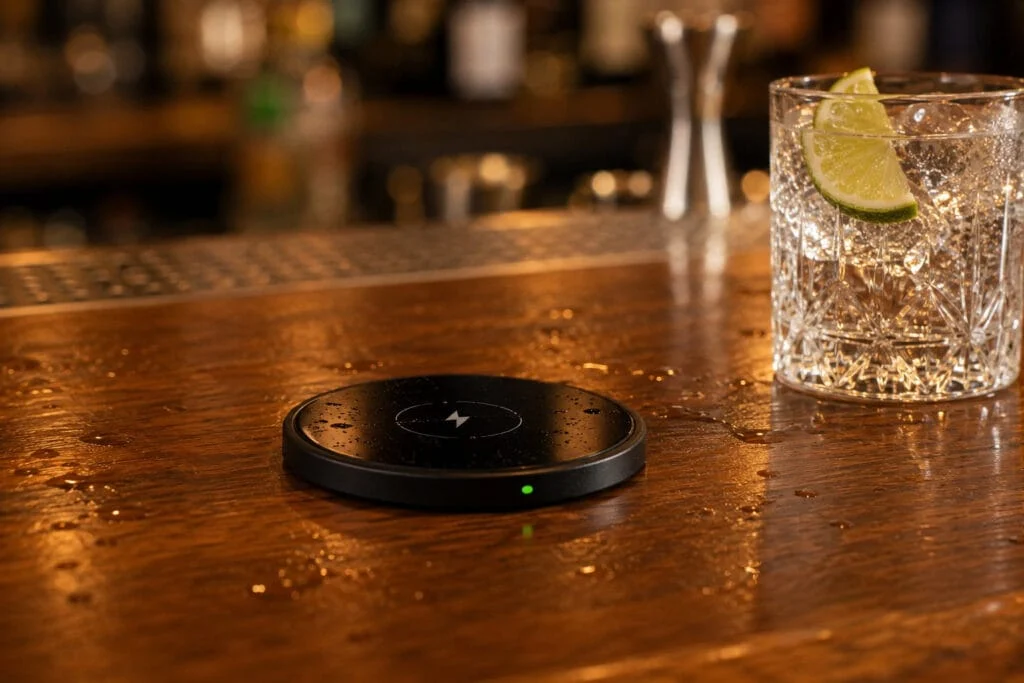
The SwiftPro 25W is the built-in unit: a single 15mm hole, fastened from below with a screw-nut, sitting about 7.5mm proud of the surface (low-profile, not flush). It installs through laminate, timber, stone or composite from 10mm to 50mm thick, which covers almost any bar top or table, and its construction is spill-resistant for a room where drinks get knocked over.
The ChargeHUB 25W is the standalone unit: a reinforced steel base with an integrated drink holder, for seating that has no surface to drill into. Both deliver 25W Qi2.2 charging with magnetic alignment, carry a two-year commercial warranty, and are RCM marked and AS/NZS compliant, supplied by an Australian-owned company with Queensland-based support.
Does it pay for itself?
Lead with the room, then check the numbers. Charging that just works is a quiet, constant signal that the venue was built around the patron, and it removes one of the few causes of an early departure a venue can remove entirely.
The numbers hold up underneath that. For a medium-sized venue, a supply-only deployment of around 80 charging points is roughly $8,800, and on conservative assumptions (about 2% of patrons staying for an extra session) it typically pays back in about 7.7 months, after which there is no commission and no per-use cost. We deliberately model that on the cautious end. The return is modest, but the experience improvement pays for itself and keeps paying after that, which makes it an easy line for an owner or board to approve.
Proven in Australian venues
Stay Charged has supplied commercial wireless charging to more than 300 Australian businesses since 2017, with over 15,000 chargers installed, including Club Blacktown, Mollymook Golf Course, Gumeracha Hotel and Ballina RSL.
“Stay Charged is an easy to install device and the customers love it. At first people thought it was a bar coaster but when they learn they can charge their phone they love the idea.”
Mark Warren, Director, Gumeracha Hotel
Wireless charging is becoming standard in Australian venues, so the decision now is whether you offer the fast, reliable version before your competitors do.
Frequently asked questions
What is the difference between Qi2 and Qi2.2?
Qi2 introduced magnetic alignment, so the phone snaps into the right position automatically, but it charges at 15W. Qi2.2 raises the Magnetic Power Profile to 25W. That extra speed is what lets a patron see their battery climbing in the time they are seated, rather than wondering whether the charger is working at all.
Is Qi2.2 backward compatible with older phones?
Yes. A Qi2.2 charger still charges any Qi-compatible phone. A device that supports 25W charges at the full rate, while an older phone charges at its own maximum. Recent iPhones and Qi2 Android phones with MagSafe-style magnets also get the magnetic snap-alignment; phones without magnets still charge by sitting on the surface.
Do I need an electrician to install it?
No. Both units run from a standard power outlet. The SwiftPro 25W fits a single 15mm hole and fastens from below, and the ChargeHUB 25W is free-standing on a weighted base. Each takes only a few minutes to fit, with no rewiring.
Will it charge through a stone or timber bar top?
Yes, with the built-in SwiftPro 25W. It installs through laminate, timber, stone or composite surfaces from 10mm to 50mm thick, which covers almost any bar top or table, and it sits about 7.5mm proud of the surface rather than flush.
Is Stay Charged hardware certified and compliant for Australian venues?
Every Stay Charged unit is built to the Qi2.2 standard and is RCM marked, EMC compliant and AS/NZS compliant for the Australian market. The hardware is supplied by an Australian-owned company with Queensland-based support and a two-year commercial warranty.
How long until it pays for itself?
For a medium-sized venue, a supply-only deployment of around 80 charging points is roughly $8,800. On conservative assumptions (about 2% of patrons staying for an extra session), that typically pays back in about 7.7 months, after which there is no commission and no per-use cost.
Thinking about wireless charging for your venue? Stay Charged supplies 25W Qi2.2 wireless charging built for Australian licensed venues, with the right units, the compliance behind them, and install guidance. Book a free consultation to scope the right units and placement for your bars, tables and floor.
Written by Ryan Britz, Director at Stay Charged. Stay Charged has supplied commercial wireless charging to 300+ Australian businesses since 2017, with 15,000+ chargers installed. Australian-owned, Queensland-based, with RCM-marked, AS/NZS-compliant commercial hardware.