Resources / Licensed venues
A Dead Phone Ends the Night Early: Why Wireless Charging Is the Amenity Members Notice
A dying phone quietly ends a good night early, and the patrons most likely to leave never say a word. Wireless charging is the low-cost amenity that fixes it.

TL;DR
- A dying phone quietly downgrades a patron’s whole visit, and the most battery-anxious patrons leave without ever telling staff
- Battery anxiety is real and Australian: 3 in 5 Australians feel panic when a low-battery alert appears and there’s no power nearby
- The case for charging is the same case as good lighting, clean tables, and free Wi-Fi: a low-cost amenity that makes the visit better
- The hospitality evidence is clear in direction, if not in a single number: satisfied patrons are more loyal, and free amenities lift satisfaction
- The numbers still stack up. For a medium-sized venue, conservative modelling protects $1,144 to $2,860 a month, but the amenity earns its place long before you reach for the calculator
Every venue has had this happen, whether or not anyone noticed. A group is settled in, a few rounds deep. Then someone’s phone hits the red. There is no complaint and no scene, just a quiet “we should probably head off,” and the table empties twenty minutes before it had to.
Nobody asked for a charger or left a review. The venue lost the back half of a good visit and never found out why.
This is an experience problem first and a revenue problem second. The fix is an amenity, and it is neither complicated nor expensive.
The phone is the visit now, not a distraction from it
It is tempting to treat phones as the thing pulling patrons out of the room. In practice the phone now runs through the entire visit. It is the group chat deciding who’s coming, the photos of the night, the round split four ways, the mobile wallet that pays the tab, and the ride that gets everyone home safely.
A flat phone is increasingly a flat tab. Australians access the internet via mobile on 92% of days (ACMA, 2026), and 44% of in-person card payments are now made through a mobile wallet (RBA, October 2024). When the battery runs low, a chunk of how a patron participates in the night, and how they pay for it, starts to switch off.
So the patron does the sensible thing. They start rationing. Screen down, fewer photos, a quick check of the time instead of a scroll. They are still in their seat, but a part of them has already started planning the exit.
Battery anxiety is real, and it is Australian
Australian survey data backs this up.
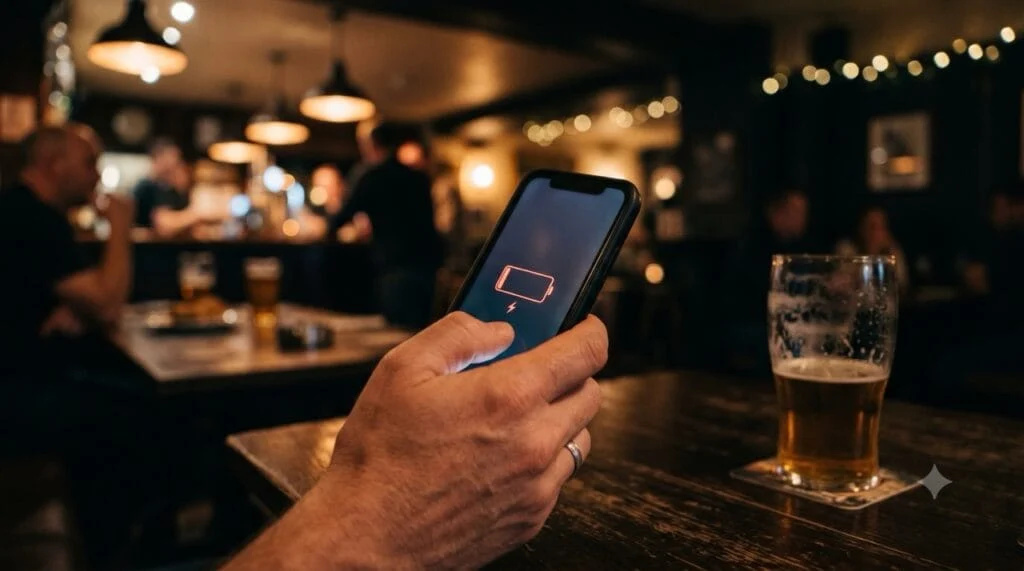
3 in 5 Australians feel panic or high distress when a low-battery alert appears and no power source is available. That is from a December 2025 Qualcomm-commissioned study of more than 1,000 Australians. It looked at battery anxiety across devices rather than phones specifically, so treat it as a general signal. The same study found 57% had resorted to charging in genuinely awkward places, including petrol stations and public restrooms, just to stay connected.
A patron who will charge their phone next to a service-station bowser is not going to relax into a long, easy evening on 9% battery. They will manage it, and then they will leave to deal with it.
The quiet ones are the issue. In a 2019 survey of more than 2,000 UK pub and restaurant patrons by Chargifi, 15% said they had left a venue early because they could not charge a dying phone, rising to 20% among those aged 18 to 44. It is UK data, so treat it as directional rather than a local measurement. But the behaviour it describes is universal: the patron most likely to leave over a dead phone is the one who will never tell you. They will not ask for a cable. They will just be gone.
Battery anxiety is a documented response with a real effect on behaviour, and it is one of the few causes of an early departure that a venue can remove entirely.
Think of it as an amenity, not an investment to be justified
You do not run a spreadsheet to justify clean bathrooms, comfortable seating, or working air-conditioning. You provide them because they make the visit better, and a better visit is the whole job. Free phone charging belongs in that category.
It is a low-cost, free-to-the-patron amenity that removes a real source of stress. Most venue managers already know this, which is why the question is rarely “is a good amenity worth it?” and more often “is this particular one worth the install?”
The research backs the instinct, though it offers no tidy formula. The link between guest satisfaction and loyalty is one of the most consistently evidenced relationships in hospitality. A 2025 meta-analysis of 153 hospitality and tourism studies in Cornell Hospitality Quarterly found that customer satisfaction is the dominant driver of loyalty. Closer to home, a University of Queensland study of an Australian restaurant group (Solnet, Ford and McLennan, 2018) confirmed the long-standing service-profit chain: better experience leads to satisfaction and loyalty, which shows up as revenue over time. The same study found the payoff arrives gradually, as revenue, rather than as an instant profit spike.
For amenities specifically, the cleanest parallel is connectivity. A study of more than 26,000 hotels found that offering free Wi-Fi lifted guest ratings by up to 8%, while several other amenities moved the needle barely at all. That is 2011 hotel data about a free connectivity amenity, so it is an analogue rather than proof about phone charging. But the shape is familiar: when a venue removes a connectivity friction for free, guests notice and rate the place higher. Wireless charging is the same kind of amenity, aimed at the same kind of friction.
We are not going to pretend there is a study showing that a charging pad produces a precise lift in spend. There isn’t, and it does not need one. What we will claim is that a low-cost free amenity that removes real friction is generally good for the experience, and good experiences bring patrons back.
What most venues have already tried
Most venues have not ignored the dead-phone problem. They have reached for the obvious fixes, and found each one falls short for a specific reason.
Staff-managed cables
A box of cables behind the bar feels like a solution, but it interrupts service, walks off, and never reaches the patron most at risk: the quiet one who will not ask. Rationing privately and leaving privately is the default for most battery-anxious patrons, and a cable they have to request does nothing for them.
Old consumer wireless chargers
Cheap pads from an electronics shop run at 5 to 7.5W. A patron sitting for 90 minutes gains roughly 8% battery, which is below the level where anything changes. They glance at their phone, see the same number they started with, and conclude wireless charging does not work. The conclusion is fair for the product they tried. It does not hold for the category.
Power bank rental kiosks
Rental models make sense in transit settings like airports, where people are already moving. In a seated venue they are structurally backwards. They generate usage by getting the patron up and out of their seat, which is the opposite of what a venue wants.
Each was built for a different situation and borrowed into this one.
What actually fits a seated venue
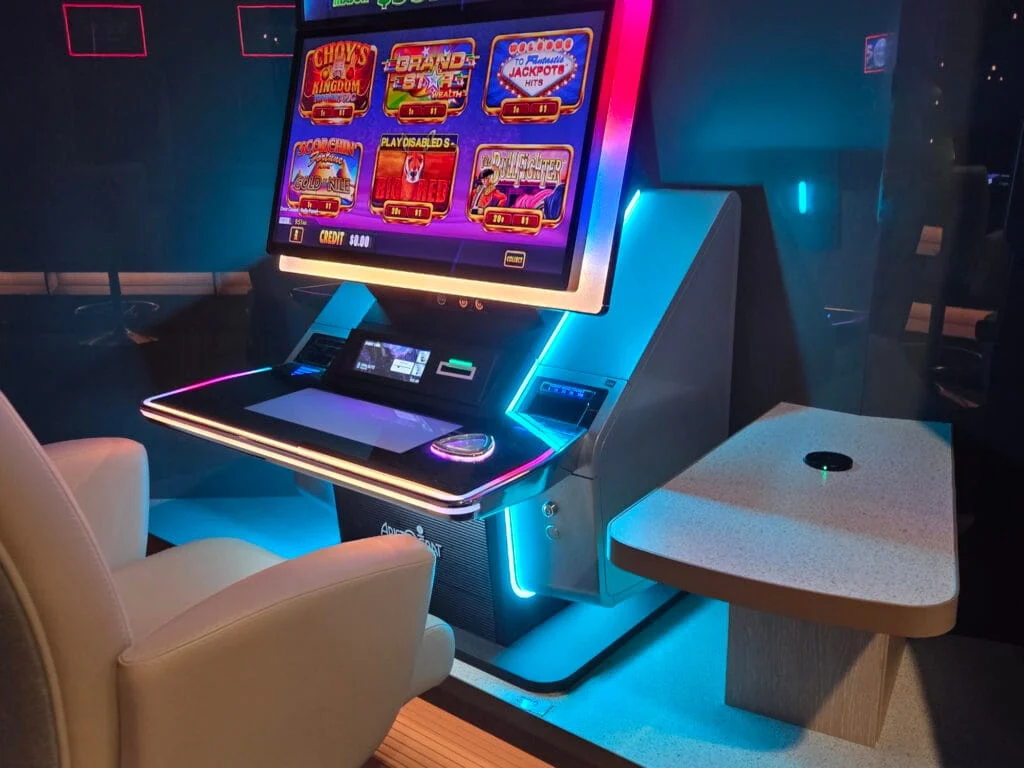
Fixed wireless charging built into the seating area solves what the workarounds could not. The phone charges where the patron already is, with no cable, no staff involvement, and no reason to get up.
Speed matters most. A modern 25W Qi2.2 unit moves a phone from anxious to comfortable inside a normal visit. That is enough headroom for the patron to stop managing their battery and enjoy the night, use the loyalty app, pay from their phone, and book a safe way home at the end of it.
Stay Charged builds two units for different fit-outs:
- ChargeHUB 25W is a standalone charging unit with an integrated drink holder, designed for seating areas where there is no surface to drill into.
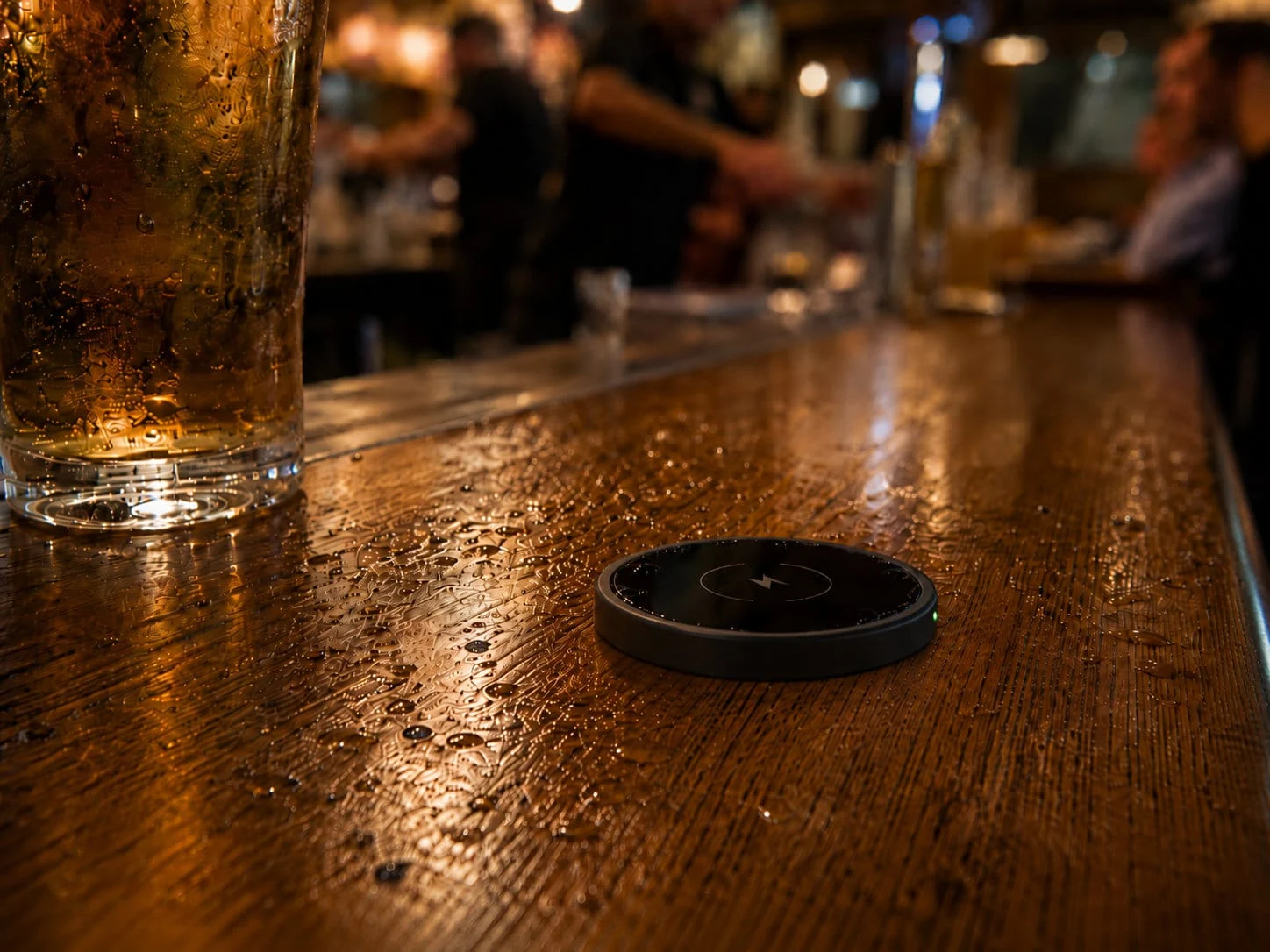
- SwiftPro 25W installs into tables and counters through a single hole, sitting low and clean on the surface, and suits restaurants, hotel bars, and function spaces.
Both deliver 25W Qi2.2 fast charging with magnetic alignment, spill-resistant commercial construction, Australian compliance marks, and a two-year commercial warranty. They are supply-only and go in fast, usually fitted by the venue’s own maintenance team or during renovation rollouts.
The feedback from Australian venues is consistent. These are directional observations, not measured studies.
“Members and guests love the convenience, and the peace of mind that comes with knowing their devices are safely charging next to them.”
Ethan Dean, Club Blacktown“The customers love it,” and patrons “actually stay longer within the premises.”
Mark Warren, Director, Gumeracha Hotel
Neither venue handed us a stopwatch and a spreadsheet, and we are not going to invent one. The pattern across more than 300 businesses and 15,000-plus chargers installed since 2017 is that patrons notice, and managers keep them in.
It is the same arc free Wi-Fi travelled, from a nice extra to an expected standard. Charging is moving along the same line.
And yes, the numbers do hold up
The question always comes eventually, and the financials are sound. They are just the second reason, after the experience.
For a medium-sized venue, conservative modelling protects roughly $1,144 a month, rising to about $2,860 under more moderate assumptions. Those figures are deliberately cautious. They count only nine busy trading evenings a month rather than every day the doors are open, and they assume only a small share of patrons change their behaviour. On the conservative end, payback lands around 7.7 months, after which the amenity simply keeps doing its job.
They are projections built on transparent assumptions, not reported customer results, and they vary by venue. You can model your own venue if you want the exact shape of it. The amenity earns its place because it makes the night better for the people you most want to keep. The payback is the reassurance that doing the right thing for patrons also makes sense on paper. If you would rather see it before committing, contact our team for a sample product to test in your venue.
Frequently asked questions
Is wireless charging really worth it for a venue?
Treat it as an amenity first, like good lighting or free Wi-Fi. It removes one of the few causes of an early departure a venue can remove entirely. The numbers also hold up (conservative modelling protects $1,144 to $2,860 a month for a medium-sized venue, with payback around 7.7 months), but the amenity earns its place before you reach for the calculator.
How fast does it charge?
Fast enough to notice. A 25W Qi2.2 unit takes a phone from about 20% to 70% in roughly 33 minutes, which is the point where a seated patron stops managing their battery and relaxes into the night.
Do patrons need a special phone or case?
No. The units use the Qi2.2 standard, which works with effectively every modern smartphone. Recent iPhones and Qi2 Android phones also snap into magnetic alignment, and other phones charge by resting on the surface.
Will it create work for my staff?
No. It is self-serve and supply-only. The phone charges where the patron is already sitting, with no cable to hand out, nothing to mind behind the bar, and no request for staff to field during peak hours.
What does it cost to run?
Nothing per use. It is free to the patron, with no commission and no per-use fee. After payback (around 7.7 months on conservative modelling) it keeps doing its job.
Wireless charging is a low-cost amenity that makes the visit better, and the kind of thing patrons remember. See how it works for your venue or model the numbers for your specific space.
A dead phone is one of the few reasons a good patron leaves early that you can fix.