Resources / Licensed venues
Power Bank Rentals vs. Built-In Wireless Charging: An Honest Comparison
Rental kiosks pay venues $50-$200 / month in commission. Built-in wireless charging costs nothing after payback. Here’s how the two compare for patrons and venues.
There are two ways venues are solving the dead battery problem right now.
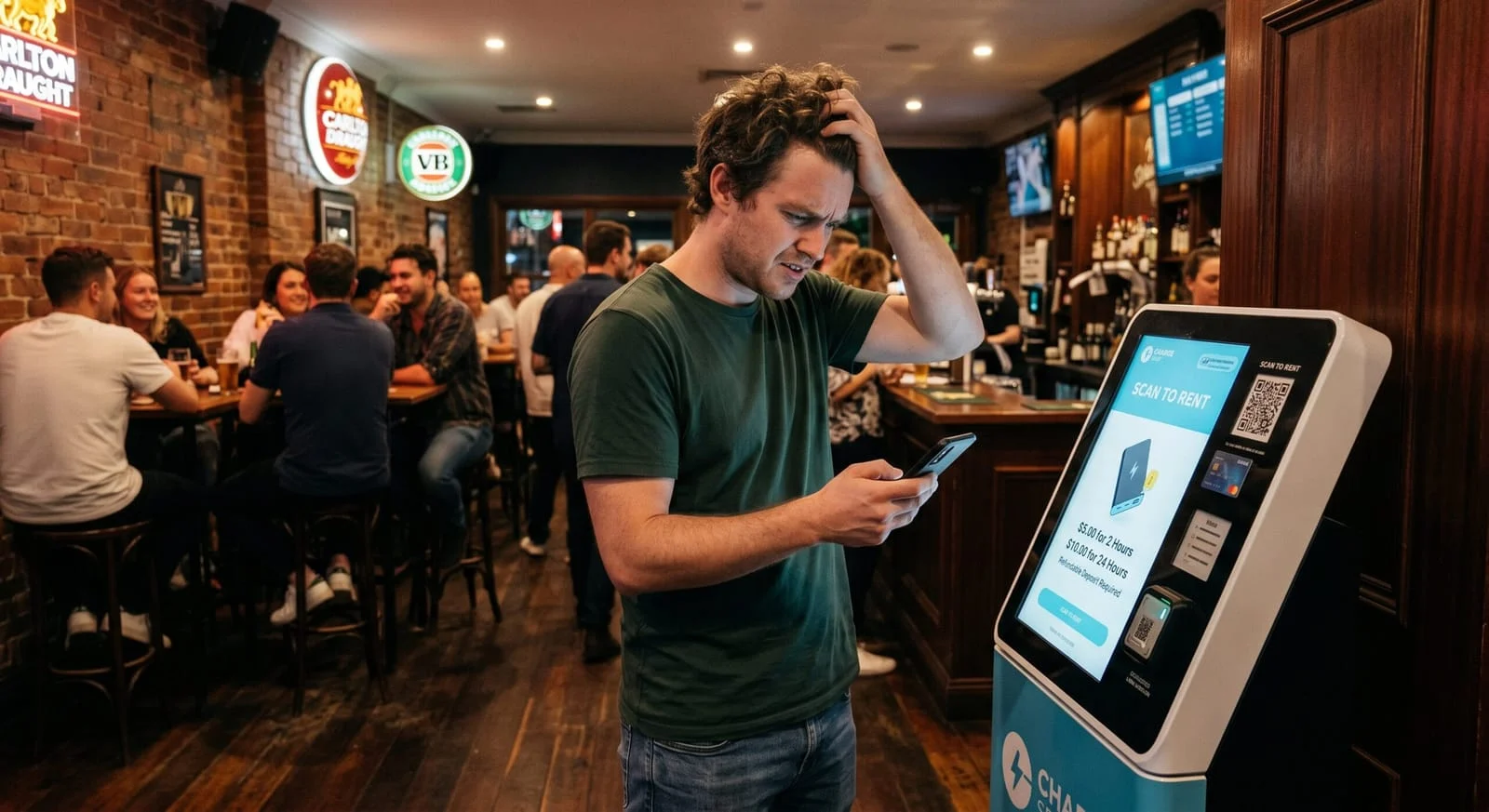
The first is a rental kiosk. A third-party company installs a unit in your venue, patrons pay $3-$8 to borrow a power bank, and you receive a small commission on each transaction.
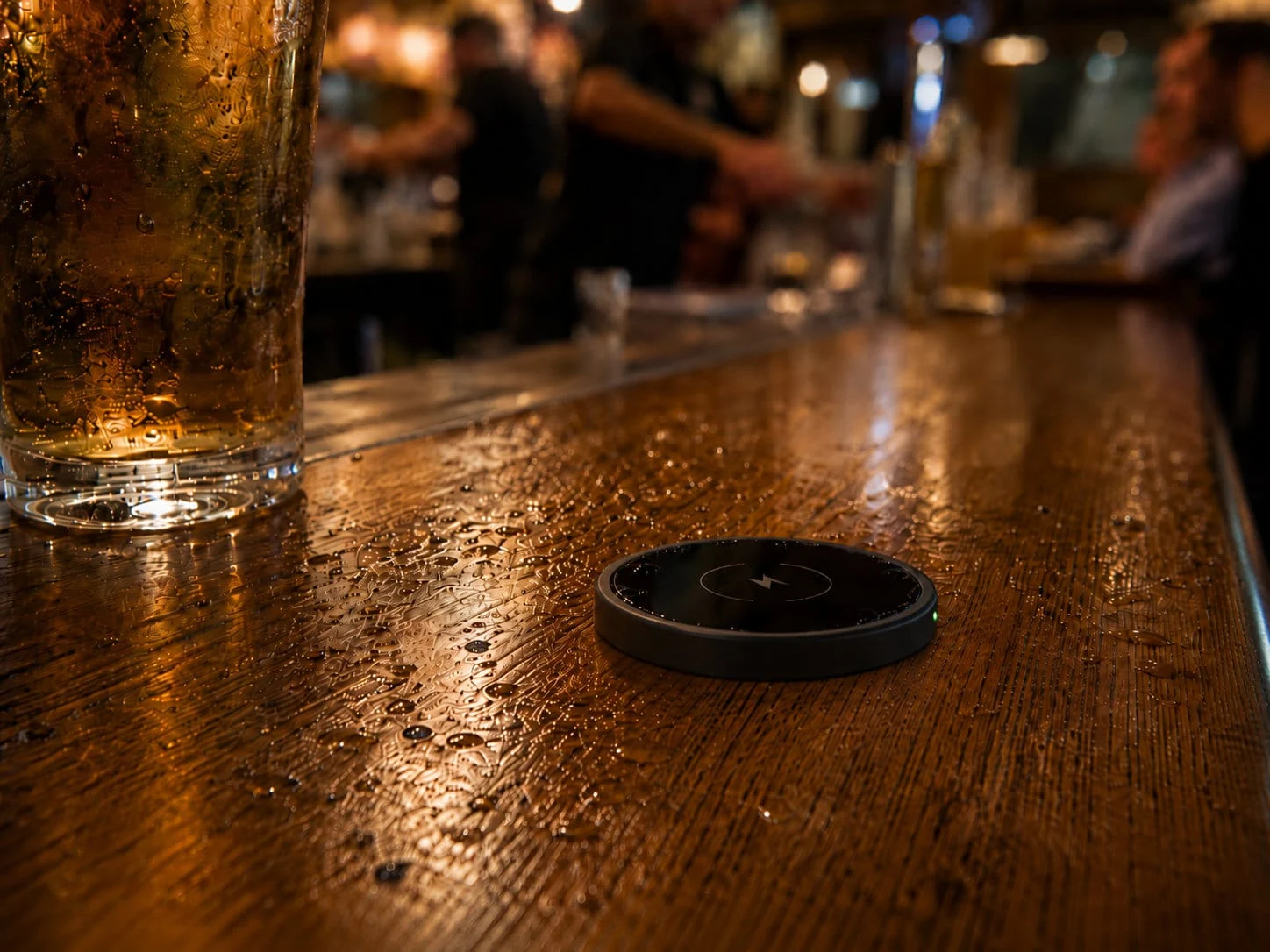
The second is integrated wireless charging: chargers built into your tables and surfaces, patrons place their phone down and it charges, no payment required.
Both technically solve the problem. But the patron experience each delivers, and what it signals about your venue, couldn’t be more different.
What the Rental Experience Actually Looks Like
Put yourself in the patron’s position.
Your phone hits 15%. You spot a rental kiosk across the room. You walk over, navigate the payment interface, tap your card for $5, pull out a power bank, and walk back to your seat trailing a cable. For the next hour you’re aware of the power bank sitting next to your drink, a timer you need to manage. When you’re ready to leave, you have to remember to return it to a kiosk, preferably near the exit, before the rental period expires.
At every step there’s friction. At every step there’s a cost: money, attention, and the growing feeling that the venue is charging you for something that should simply be included.
The patron’s internal monologue isn’t “great, they have a charging solution.” It’s “I have to pay to charge my phone here?”
The Commission Conversation
To be fair, rental kiosks do generate venue revenue. A typical venue commission is $50-$200 per month.
For $50-$200 a month, your venue is asking patrons to pay for a service that directly affects how long they stay, and to navigate friction and carry equipment at a venue designed to help them relax. It also signals that the venue is more interested in extracting value than adding it.
Would you charge patrons for WiFi access? Most venues wouldn’t, not because WiFi is free to provide, but because the goodwill of offering it freely is worth far more than the revenue from charging for it. Phone charging is the same conversation.
One honest difference: a rental power bank works for every phone, including older models and phones in thick cases. Built-in wireless charging works for the majority of modern smartphones, and that majority is growing every year as wireless charging becomes standard. If universal coverage is a requirement, it’s worth discussing a hybrid approach.
The commission is real. The question is whether it’s worth the goodwill it costs you.
Rental vs Built-In at a Glance
Power bank rental | Built-in wireless charging | |
|---|---|---|
Who pays | The patron ($3-$8 per use) | The venue (one-off, around $8,800 for 80 units) |
Venue revenue | $50-$200/month commission | None (cost recovered in about 7.7 months) |
Patron effort | Borrow, manage a cable, return before leaving | Place the phone down |
Ongoing cost | Commission split; terms can change | None after payback |
Device coverage | Every phone, including older models | The majority of modern smartphones |
What it signals | “We charge for this” | “We thought of everything” |
Which Venue Would You Go Back To?
Patron A visits a venue with a rental kiosk. Their phone is low. They pay $5, manage the power bank for an hour, return it before leaving. The problem was solved, technically.
Patron B visits a venue with integrated wireless charging. Their phone is low. They place it on the charger at their seat, feel it connect, and stop thinking about it. They order another drink. They stay another hour. When they leave, their phone is charged and they feel like the venue thought of everything.
Which venue does each patron go back to next Friday?
The first patron solved a problem. The second had an experience.
What Built-In Wireless Charging Actually Costs
The investment for a medium venue (80 units) is approximately $8,800 (supply only), comparable to a minor fit-out update, and less than a single equipment refurbishment. Based on 2% of patrons staying an additional session, and only on your nine busiest nights each month, a medium venue typically sees payback in about 7.7 months. Those are deliberately conservative assumptions. After that, the infrastructure runs with no ongoing commission or per-use cost.
There’s no commission to split and no risk of the rental company changing terms or exiting the market. You forgo the $50-$200 a month in commission, and after the payback of about 7.7 months you’re earning the goodwill of every patron who placed their phone on your table and thought: this venue gets it.
That’s harder to put a number on. But it’s easy to know which one builds a venue people return to.
If you want to see what the investment looks like for your venue, conservative ROI model, real venue data, download the free business case below.
Common questions
Do power bank rental kiosks cost the venue anything?
No. The kiosk operator typically pays the venue a small commission, around $50 to $200 a month. The real cost is the patron experience: patrons pay $3 to $8 per use and manage a borrowed unit, which signals that the venue charges for something most people now expect to be included.
Does built-in wireless charging work with every phone?
It works with the majority of modern smartphones, and that share grows every year as wireless charging becomes standard. Rental power banks still cover every phone, including older models and thick cases, so venues that need universal coverage sometimes run a hybrid of both.
What does built-in wireless charging cost to install?
For a medium venue (80 units) the supply-only investment is around $8,800. On conservative assumptions (2% of patrons staying an extra session) that typically pays back in about 7.7 months, after which there is no commission or per-use cost.
Written by Ryan Britz, Director at Stay Charged. Stay Charged has supplied commercial wireless charging to 300+ Australian businesses since 2017, with 15,000+ chargers installed. Australian-owned, Queensland-based, with RCM-marked, AS/NZS-compliant commercial hardware.