Resources / Offices
Office Fitout Wireless Charging: Speccing Charging Into Desks and Joinery
During a fit-out the surfaces are open and power is already run. Speccing charging in now costs minutes per desk; adding it later means lifting finished benchtops.
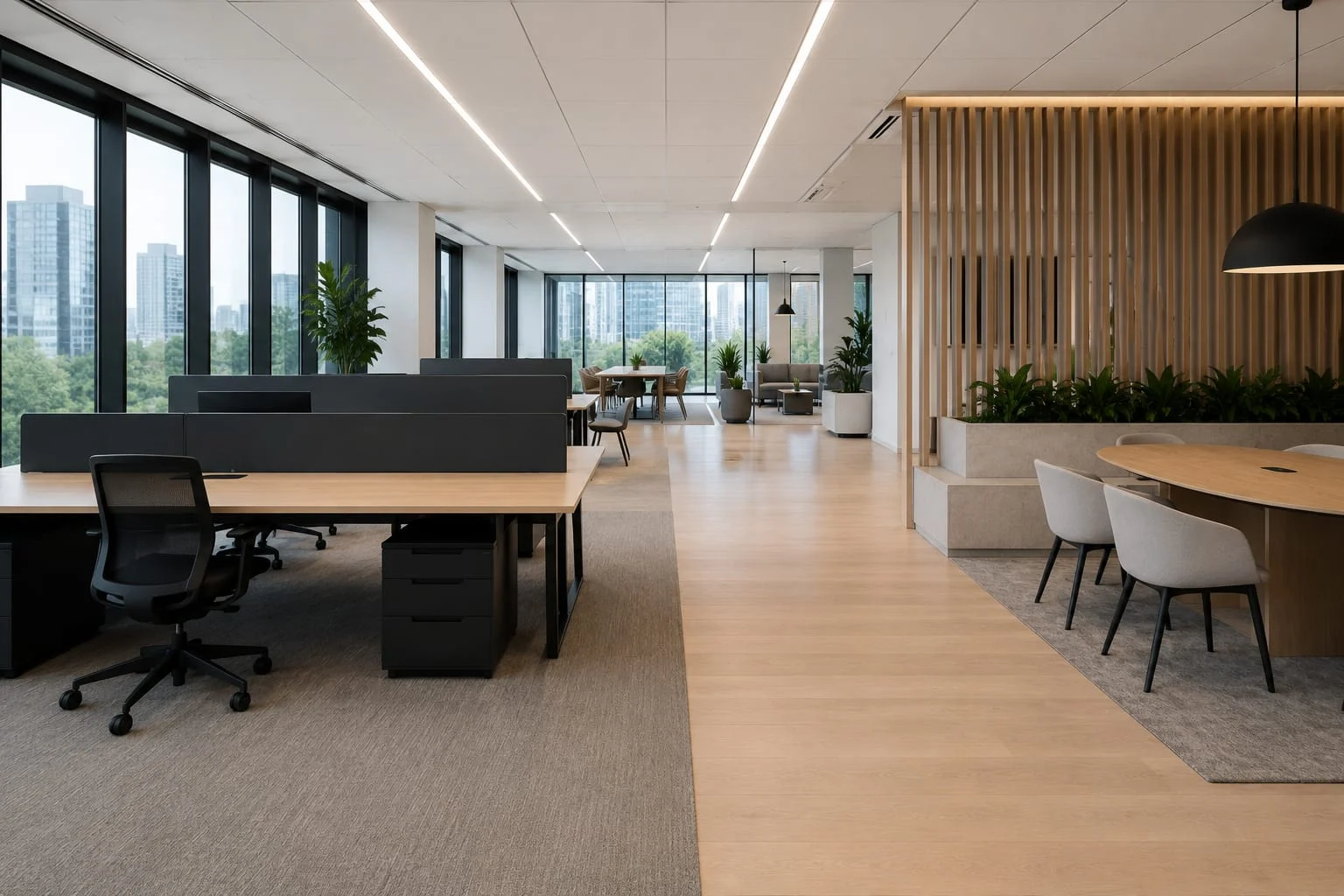
The short version: office fitout wireless charging is decided at the design table, before the joinery is finished. Spec it into the furniture and it disappears. Add it later and it shows.
- The cheapest moment to integrate charging is during the fit-out, while surfaces are open and cabling is being run anyway.
- Charging belongs in desks, reception, and boardroom tables, the surfaces everyone touches.
- The spec that matters: 25W, RCM marked and AS/NZS compliant, and fastened from below, with only a low 7.5mm pad on the desk.
- For joinery and fitout partners, sourcing a compliant unit also moves a real liability off your books.
Every fit-out makes a hundred small decisions about what gets built in and what gets left to chance. Lighting, data, and power are designed in from the first drawing. Phone charging, almost always, is not. It gets remembered late, solved with a box of pads, and ends up as the one part of a polished space that looks improvised.
It does not have to be that way, and the economics say it should not be. The Australian office fit-out market was valued at around USD 2.61 billion in 2024 and is projected to reach USD 4.55 billion by 2032, a fit-out market growing at 7.21% a year. A rising share of that spend is going into technology integration. Charging is the next obvious thing to design in rather than add on. This is the build-time view of the wider office wireless charging decision: the same hardware, specified before the joinery is closed rather than bolted on after.
Why spec wireless charging during the fitout, not after?
Because the work is already being done. During a fit-out the surfaces are open, the joinery is being cut, and power is being run to the furniture anyway. Adding charging at that point is a marginal task. Adding it afterwards means lifting finished benchtops, re-running cable, and disturbing a space that is already in use.
The cost gap between the two is large and entirely avoidable. Build-time integration is measured in minutes per unit and a single hole in joinery that is still on the bench. A retrofit is measured in trades returning to site, finished surfaces coming up, and the room being out of action while it happens.
There is a quality gap too. Charging designed in from the start sits low and clean and reads as part of the room. Charging added later almost always looks added later. For a space that someone has paid a fit-out budget to get right, that visible compromise is the part that grates.
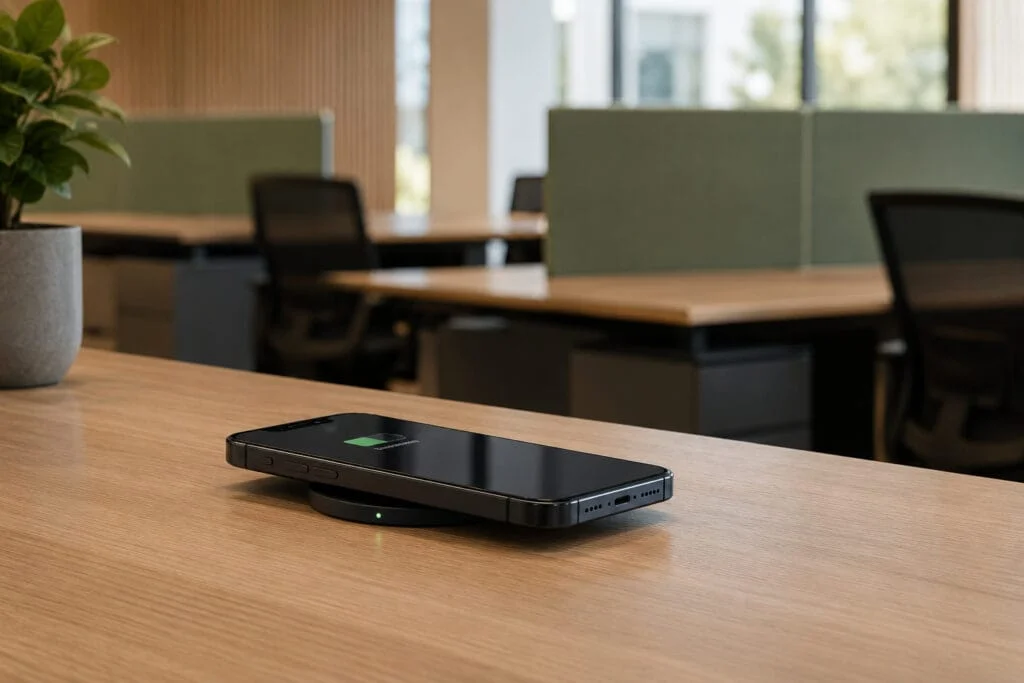
How do you build wireless charging into a desk or joinery?
You mount the unit under the surface and charge straight through it. A wireless charger works by induction: a coil in the unit creates a magnetic field, a coil in the phone turns it back into current, and the device charges with no plug. The standard behind it is Qi, maintained by the Wireless Power Consortium, so a single point charges any modern phone.
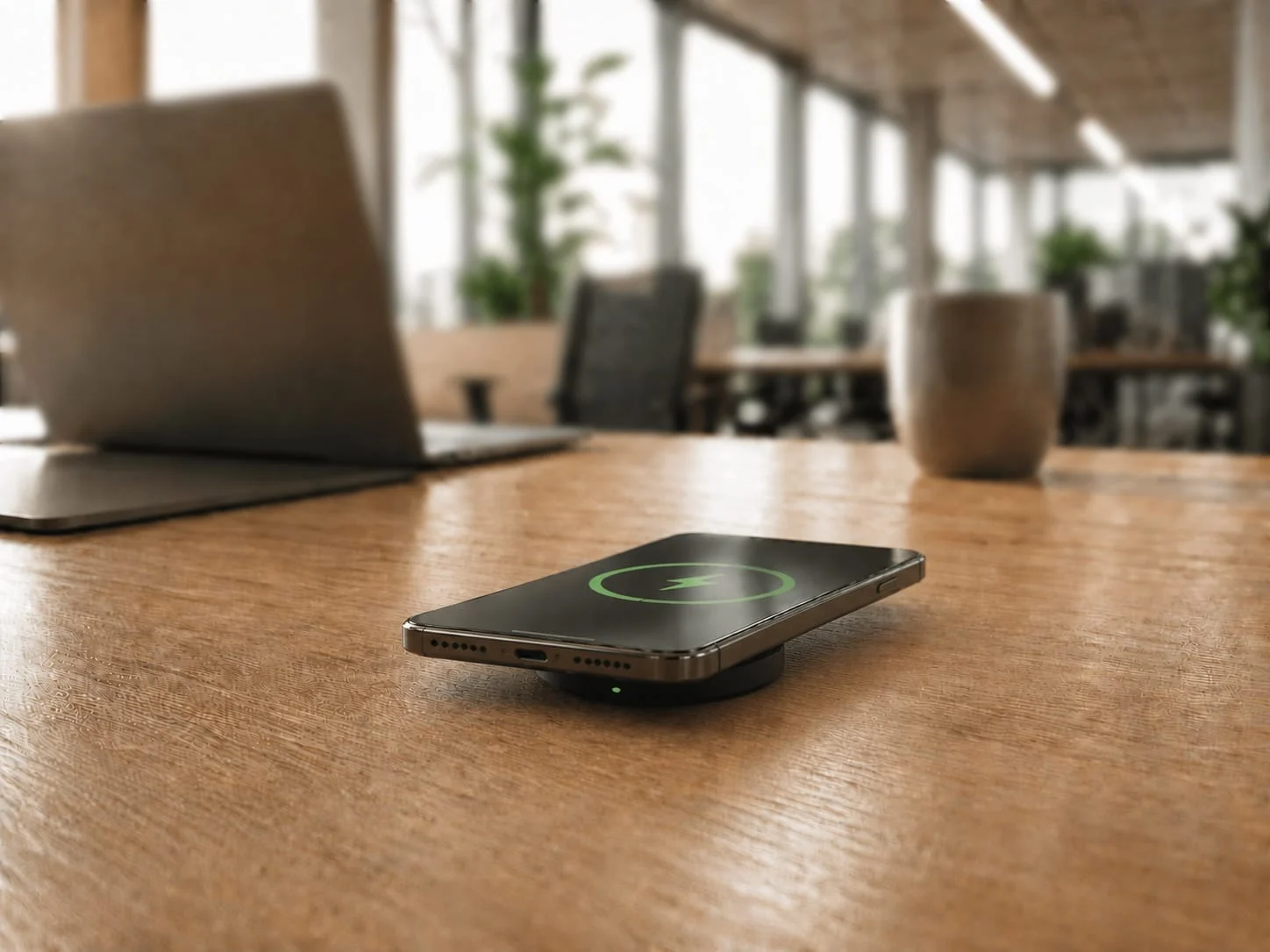
A purpose-built unit like the SwiftPro 25W fits through a single 15mm hole and fastens from below with a screw-nut, so there are no visible surface screws, and only the low 7.5mm pad sits on the desk. It installs through laminate, timber, stone, or composite surfaces between 10mm and 50mm thick, which covers almost any commercial desk or benchtop. No electrician is required: maintenance or install staff fit it in minutes.
Cable management is part of the same job. Because the unit mounts underneath, its lead runs inside the joinery to the nearest power, which is exactly where the fit-out is already routing cable. The surface stays clear and the cabling is hidden in the furniture rather than trailing across it. That is the difference between integration and a pad on a cord, and it is only easy to achieve while the joinery is open.
The version of Qi still decides the outcome. Older pads run at 5W to 15W and barely move a battery. Specify a unit that meets Qi 2.2 MPP standards at 25W, with magnetic alignment, or the finished desk will charge too slowly for anyone to trust it. Our Qi2 charging explainer covers the standards in detail.
Where in the fitout should charging go?
Put it on the surfaces everyone shares and returns to. Three locations earn it in almost every office.
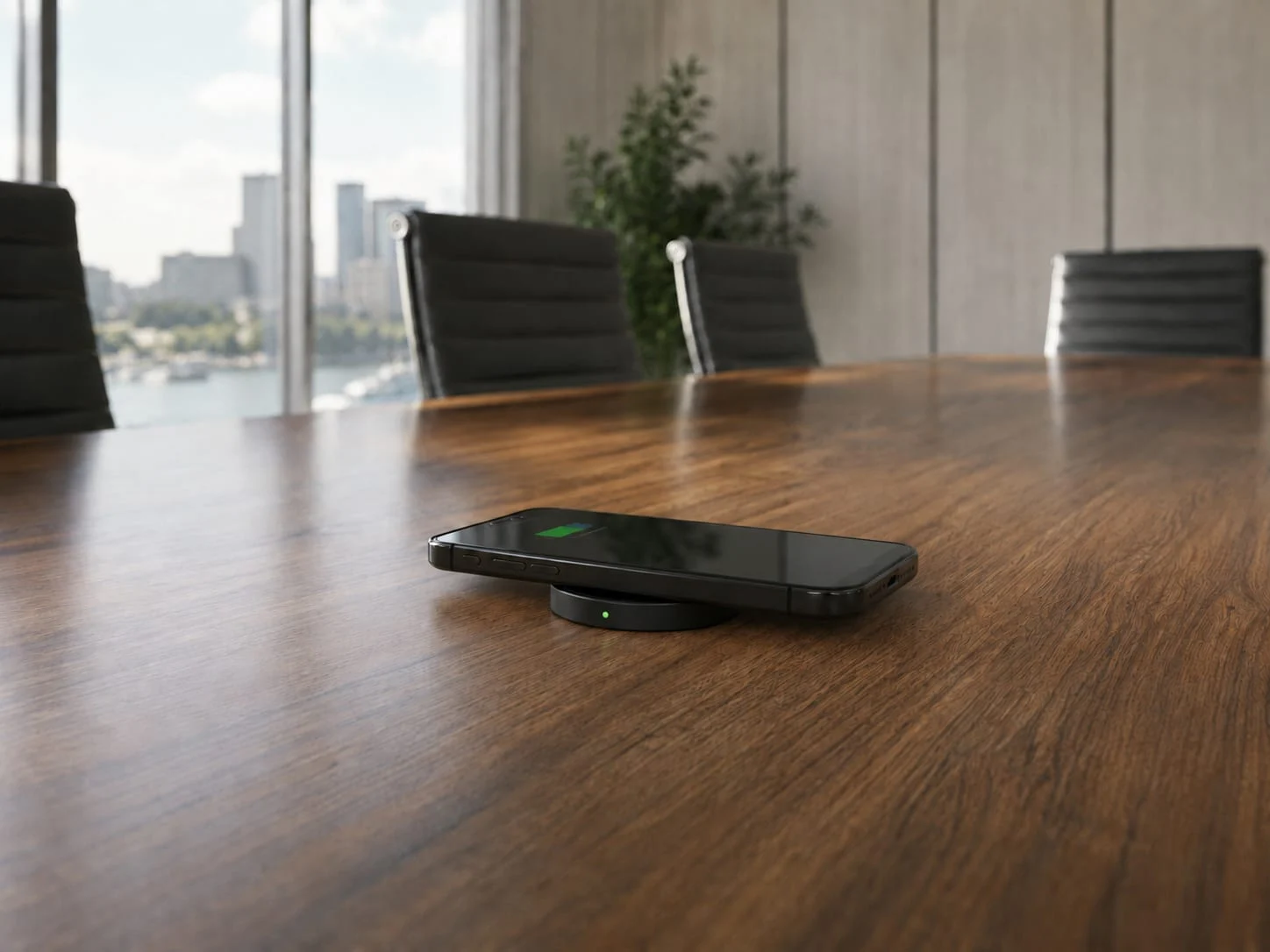
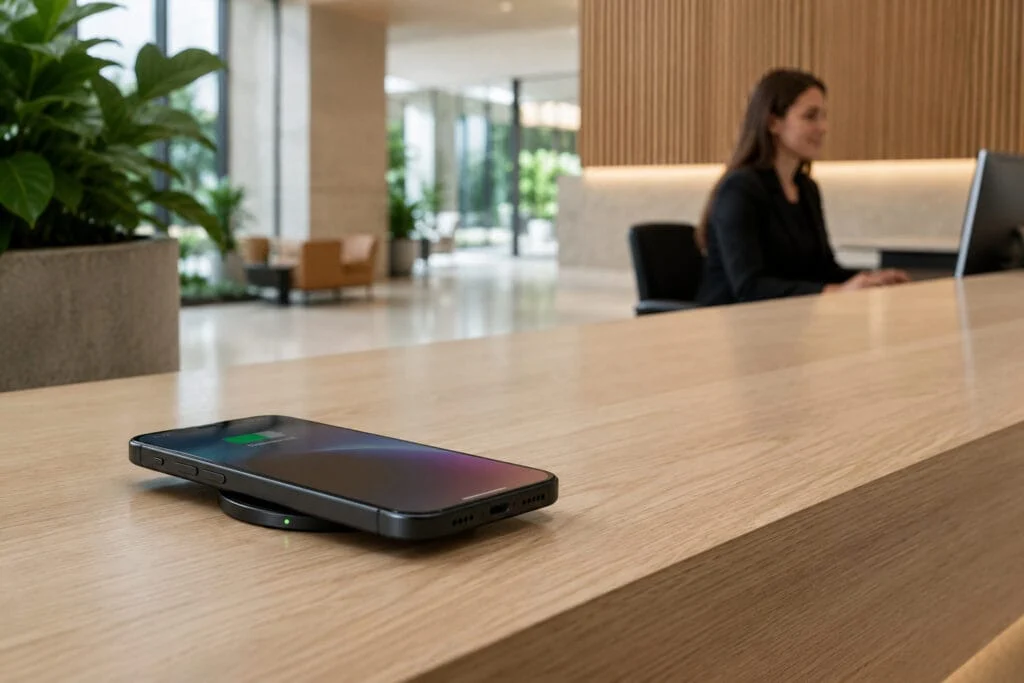
Desks come first, especially shared and hot-desk benches where nobody brings their own charger. A built-in desk wireless charger at each position turns the desk itself into the power source. Boardroom and meeting tables are next, because every participant arrives with devices the meeting depends on. We cover meeting and boardroom tables in detail separately, since shared, mixed-device use makes them the hardest case to get right. Reception is the third, and the most overlooked: a reception desk with wireless charging gives visitors somewhere to top up while they wait, on the one surface that sets the first impression of the space.
Beyond those, breakout benches, cafe-style collaboration tables, and quiet-room ledges all suit integrated charging. Wherever people sit with a device and stay a while, the furniture should charge it. That is what turns wireless charging furniture from a novelty into a consistent part of how the floor works.
Build-time versus retrofit: the real cost
A charger’s unit price is only part of what it costs. The rest is getting it into the building and keeping it working, and that is where build-time and retrofit land in very different places.
At build time, the cost is the unit plus a few minutes of labour into joinery that is already open. At retrofit, the cost is the unit plus a site visit, surface removal, re-cabling, making good, and downtime. The hardware is the small part either way. The labour and disruption are where retrofit gets expensive.
Consider a single floor with twenty shared desks, a reception desk, and two meeting tables. Speccing charging into that joinery at build time adds a handful of holes and a few minutes per unit to work already underway. Coming back a year later to achieve the same result means a return site visit, lifting finished surfaces, re-running cable, and taking desks out of use while it happens. The hardware bill is almost identical. Everything around the hardware is not.
The market is heading the same way. Australian fitout trends for 2025 point to deeper technology integration and flexible, reconfigurable spaces, with investment leaning toward refurbishing existing offices rather than building new. A refurbishment is the ideal window to add charging, because the surfaces are open exactly once. Miss it, and the next clean opportunity is the following refurbishment cycle, years away.
What should be on the spec sheet?
Treat charging as a specified component, with the same line-item rigour as power and data. Five requirements decide whether the finished install works.
- Speed. 25W, meeting Qi 2.2 MPP standards, with magnetic alignment. This is the only tier that returns useful charge in a normal sitting.
- Certification. RCM marked and AS/NZS compliant for the Australian market. A generic import usually cannot demonstrate this.
- Durability. Rated for daily shared commercial use, with a commercial warranty. The SwiftPro 25W carries a 24-month commercial warranty.
- Surface fit. Confirm the unit suits the surface material and thickness. A 10mm to 50mm range covers most commercial joinery.
- Clean install. Fastened from below, no visible surface screws, nothing sitting on top of the finished surface.
Get those five on the drawing and the install behaves predictably. Leave them vague and you inherit whichever cheap pad someone buys to fill the gap.
The compliance question every fitout partner should ask
Who is the importer of record? Most joinery and fitout firms never think to ask, and the answer carries real exposure. A firm that imports its own wireless charging components and installs them in a commercial space becomes the importer of record for that hardware.
That matters because RCM marking on a self-sourced import is not automatic. It requires conformance testing that the importer has to commission, and if a unit fails in the field, the liability sits with the firm that installed it, not the overseas manufacturer. Most firms doing this are unaware of the position they are in.
Sourcing a supplied, already-compliant product moves that exposure off the partner’s books. It is one of the reasons fit-out and joinery specialists increasingly prefer to integrate a supplied unit rather than a generic component, and why Stay Charged supports joinery partners with product data, install training, and the compliance backing behind the hardware.

Does integrated charging actually add value to a fitout?
Yes, and it shows up in two places: the end client’s experience and the project itself. For the client, charging that just works is a small, constant signal that the space was designed around the people in it. JLL’s research found nearly 40% of employees think their office experience could be better, and the quality of the fit-out is part of that judgement. A desk that charges a phone the moment it is set down is one more reason the office feels considered.
For the fit-out itself, integrated charging is a future-proofing decision. Phone dependency is not retreating, so a surface built to charge keeps the space current for longer than one strung with adapters. For trade partners, it is also a way to lift the value and margin of a project: standard joinery becomes a higher-value, technology-ready installation.
Frequently asked questions
Who is the importer of record, and who carries the compliance liability?
A firm that imports its own wireless charging components and installs them in a commercial space becomes the importer of record for that hardware. RCM marking on a self-sourced import is not automatic, and if a unit fails in the field the liability sits with the firm that installed it, not the overseas manufacturer. Sourcing a supplied, already-compliant product moves that exposure off your books.
Why spec charging into the fit-out instead of retrofitting later?
During a fit-out the surfaces are open and power is already being run to the furniture, so adding charging is a marginal task measured in minutes per unit. A retrofit means lifting finished benchtops, re-running cable, and taking a space out of use while it happens. The hardware bill is almost identical either way, but everything around the hardware is where retrofit gets expensive.
What install does it need? Do I need an electrician?
The SwiftPro 25W fits through a single 15mm hole and fastens from below with a screw-nut, so there are no visible surface screws and the unit sits about 7.5mm proud of the desk rather than on top of it. It installs through laminate, timber, stone, or composite surfaces between 10mm and 50mm thick. No electrician is required: maintenance or install staff fit it in minutes, with the lead routed inside the joinery to the nearest power.
Which Qi version and speed should I specify?
Specify a unit that meets Qi 2.2 MPP standards at 25W with magnetic alignment. Older pads run at 5W to 15W and barely move a battery, so a slower unit will charge too slowly for anyone in the finished space to trust it. The 25W tier is the only one that returns useful charge in a normal sitting.
What warranty does the hardware carry?
The SwiftPro 25W carries a 24-month commercial warranty and is rated for daily shared commercial use. It is RCM marked and AS/NZS compliant for the Australian market, which a generic import usually cannot demonstrate. At $139 inc GST per unit, the hardware is the small part of the total cost either way.
Planning a fit-out or specifying for a client? Stay Charged supplies commercial wireless charging built for Australian workplaces, and supports fitout and joinery partners with integration, compliance, and training. Book a free consultation to scope the right units for your desks, reception, and meeting spaces.