Resources / Licensed venues
Not All Venue Charging Is Equal: A Buyer’s Checklist Before You Install
Wireless charging for venues is now a real category, which means a real spread of quality. On a product page a $30 import and a commercial system can look almost identical. They do not behave the same on a busy floor.
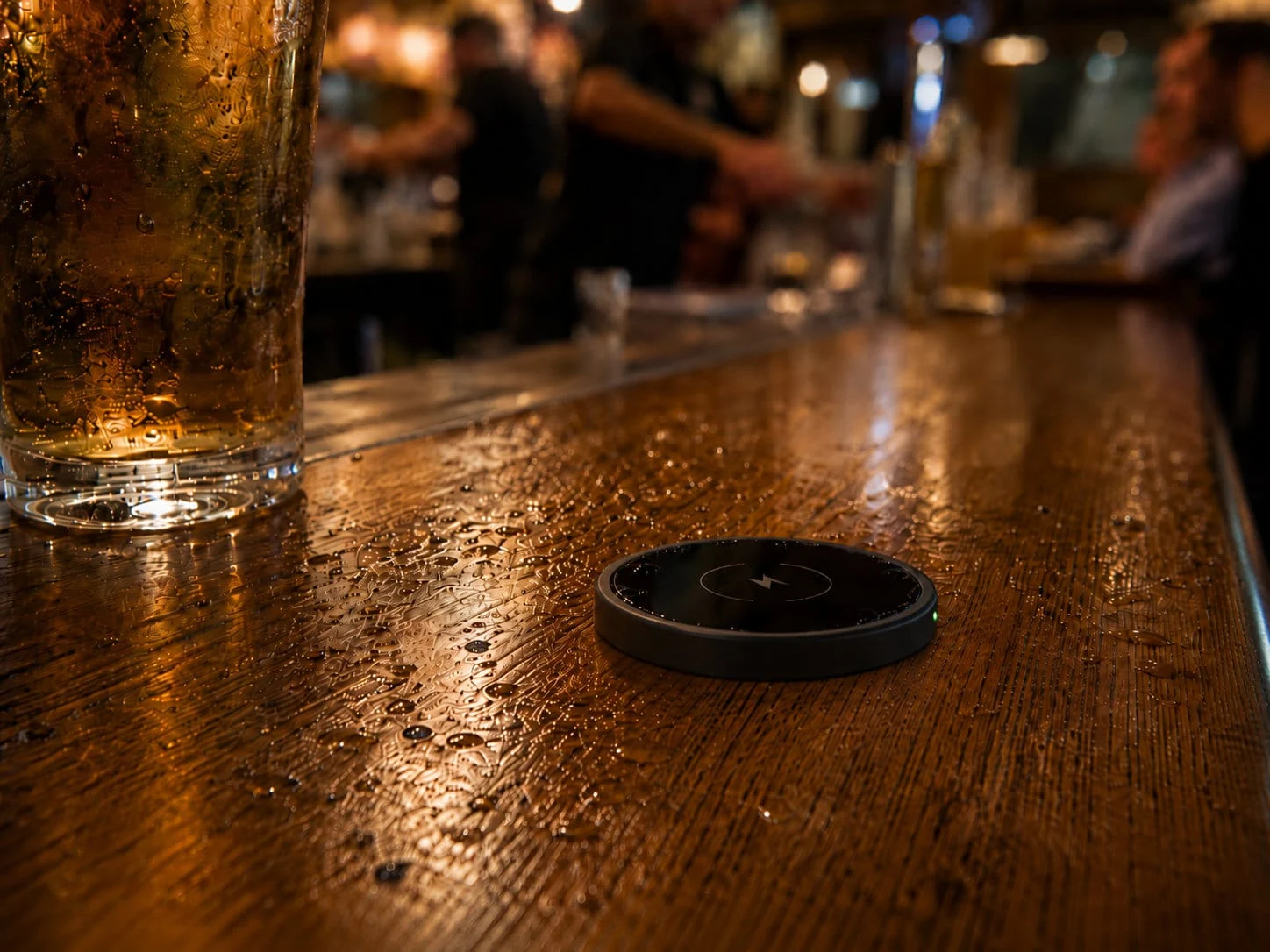
Wireless charging for venues used to be a niche almost nobody sold. Now it is a forming category, and newer entrants are appearing to chase it. That is good for the idea and harder for the buyer, because once a category fills up, the options spread from cheap repackaged consumer pads to purpose-built commercial systems, and on a website they can be difficult to tell apart. They photograph the same. The phone sits on top either way.
The difference shows up later, on the floor, in front of patrons, which is the worst place to discover it. A unit that charges too slowly gets ignored. One that is not built for constant use fails in a few months. One without Australian compliance marks quietly hands you a liability you did not know you took on. And a brand with no track record may not be there when you need a replacement.
Five checks separate real venue infrastructure from a gadget with a new label.
- Speed and alignment: 25W charges fast enough that patrons trust it, but only with magnetic alignment. A high-wattage pad that needs perfect placement underdelivers in real use.
- Durability: built for shared, all-day, drink-heavy use, with a real commercial warranty.
- Compliance: RCM marked and AS/NZS compliant, or the liability lands on you.
- Support: someone who supplies, fits, and stands behind it when a unit fails.
- Track record: an operator who has done this at scale, not a brand-new listing.
1. Charging speed, and the alignment that delivers it
This is the one that decides whether the charging gets used at all. The gap between cheap and commercial is stark:
- 5W to 7.5W (most cheap pads): barely keeps up with a phone that is on and in use. The patron sees almost no gain in the time they are sitting there, so they stop bothering.
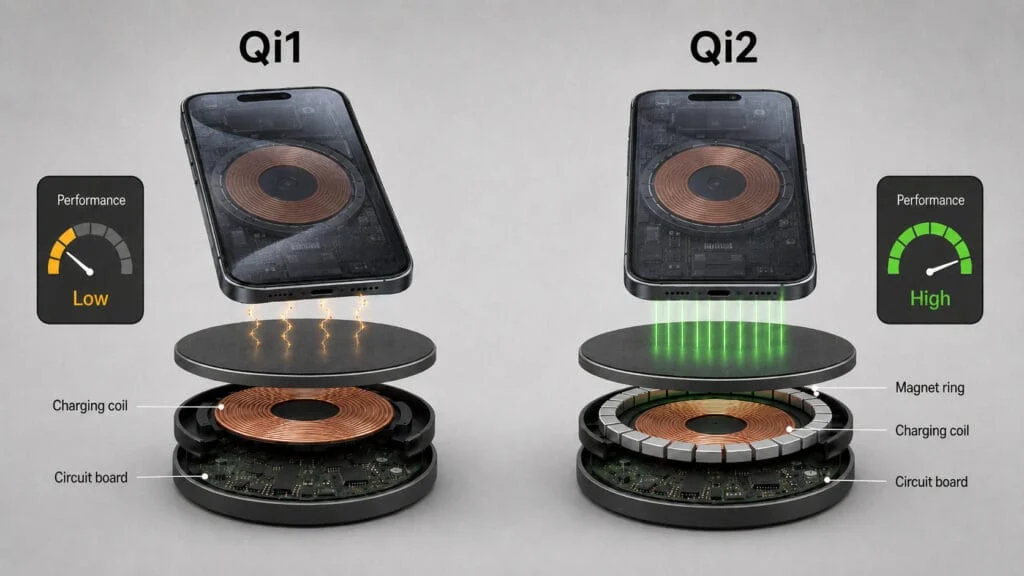
- 25W to Qi 2.2 MPP with magnetic alignment: charges fast enough that the patron notices it working, which is the whole point of having it.
The Qi standard is maintained by the Wireless Power Consortium, and Qi2 added magnetic alignment specifically to improve efficiency and open the way to higher, safe charging speeds. We cover why that speed jump is the line between trust and indifference in our Qi2 charging explainer, and it is exactly the trap behind venues who “tried wireless charging before” and gave up. They had the slow version.
Then there is alignment, the half of the speed story the wattage number hides. Wireless charging only delivers its rated speed when the phone’s coil sits almost directly over the pad’s coil. A few millimetres off, which is exactly what happens when a patron drops a phone on a flat pad without looking, and the real rate falls away fast. That is where the two designs split:
- Flat pad: asks the patron to line it up perfectly. A 15W pad with no alignment help can deliver well under its rated number, because patrons almost never place it precisely.
- Magnetic (Qi2): the magnets pull the phone into position and hold it there, so it charges at its rated speed every time, not just when someone happens to line it up.
The check: look for the wattage and the magnetic alignment, not just the word “wireless”. Two chargers with the same headline number can perform completely differently on a busy table.
2. Commercial durability and a warranty that means something
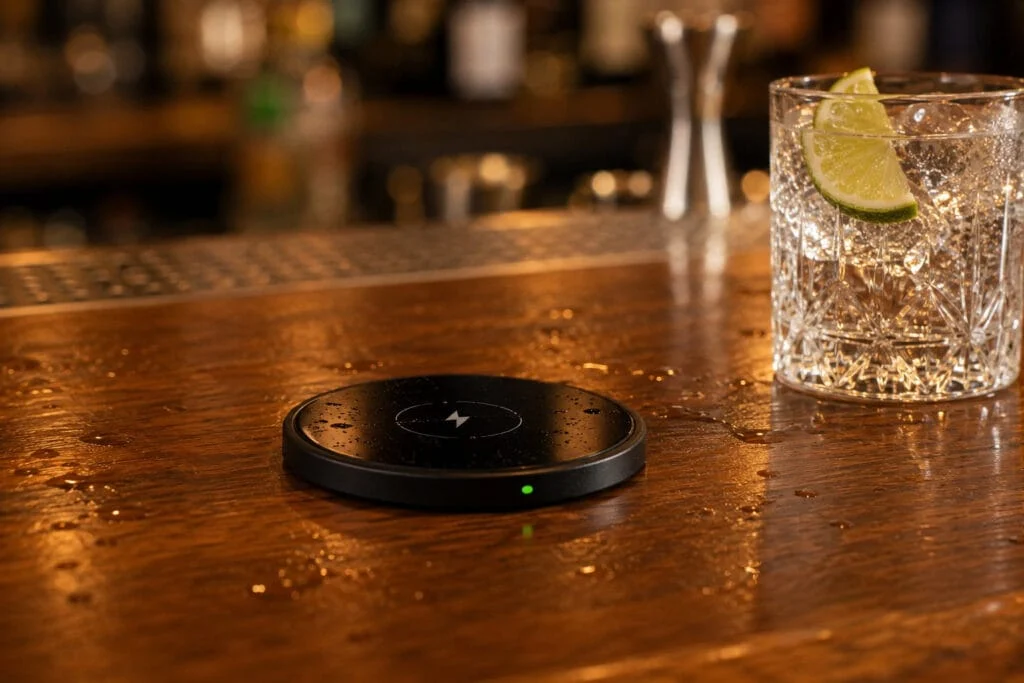
A home charger handles one phone a night. A venue charger handles dozens of devices a day, drinks beside it, and the occasional spill on top, every day, for years. Those are different products even when they look alike. Before you buy, ask whether a unit is built for the job:
- Is it rated for shared, all-day commercial use?
- Is the surface spill-resistant?
- Does it have safety protections like foreign-object detection, which pauses charging when something metal lands on the surface?
The warranty is the honest tell. Consumer products typically carry a one-year warranty written for occasional home use. A unit built for a venue should carry a commercial warranty: both Stay Charged units carry a two-year commercial warranty that covers high-frequency use. If a seller will only offer a short consumer warranty, that is them telling you what the product is really for.
3. Australian compliance, or the liability lands on you
A self-sourced import is not automatically legal to install in a commercial space here. Units installed in Australian venues should be RCM marked and AS/NZS compliant, and that compliance comes from conformance testing someone has to commission.
Under Australia’s electrical equipment safety rules, in-scope gear must not be sold unless it is marked with the RCM (EESS), and chargers that miss the mandatory standard do get pulled. The ACCC has recalled USB power adapters for not complying with the mandatory electrical standard, citing a risk of electric shock (ACCC recall).
There is a liability trap underneath this. If a venue or its fitter imports its own units, that party becomes the importer of record and carries the liability if a unit fails in the field, not the overseas manufacturer. Most buyers never realise they have taken that on. We go deeper on this in speccing charging into a club or pub fitout.
The check: confirm the unit is RCM marked and AS/NZS compliant, and confirm who carries the compliance, before anything goes into your furniture.
4. Supply, fit, and who answers when one fails
A charger sits on your floor for years, so the model behind it matters as much as the unit. Ask the practical questions:
- Who supplies it, and can they help fit it cleanly into your bars and tables?
- When a unit fails, is there local support and a replacement, or are you chasing an overseas seller through a marketplace?
- Is there actually anyone to call?
A commercial supplier treats the install and the support as part of the product. A cheap listing treats the sale as the end of the relationship. On a venue floor, the second one costs you every time a unit goes down and there is nobody to ring.
5. Track record: who is still there in three years
A forming category attracts new names, and some will not last. The charging you install today needs a supplier who is still around to support, replace, and upgrade it for the life of the fitout. So ask how long they have actually been doing this, and at what scale.
Stay Charged has supplied commercial wireless charging to more than 300 Australian businesses since 2017, with over 15,000 chargers installed, across clubs and venues like Club Blacktown, Mollymook Golf Course, and Ballina RSL. Against a brand-new entrant, “we have done this at scale for the better part of a decade” is the part of the decision that protects you after the sale.
Putting it together
None of these five checks is hard to make. They are just easy to skip when two options look the same in a photo and one is cheaper. Run them and the spread becomes obvious fast:
- Speed: 25W with magnetic alignment, not 5W to 7.5W.
- Durability: commercial-grade build with a two-year warranty.
- Compliance: RCM marked and AS/NZS compliant, with the liability handled.
- Support: a real supply-and-fit model, not a one-off sale.
- Track record: an operator who has done this at scale.
The cheap end of the market tends to fail at least two or three of them, which is exactly why it is cheap.
“Wireless charging for venues” is now a category wide enough to contain both real infrastructure and a repackaged gadget, and the buyer who knows what to ask does not end up paying twice. If you want a hand applying these checks to your venue, we are happy to have that conversation.
Choosing wireless charging for your venue? Stay Charged builds commercial-grade wireless charging for Australian licensed venues, 25W and compliant, supplied and supported, proven across 300+ Australian businesses since 2017. Book a free consultation and we will help you decide if wireless charging is right for your venue.
Written by Ryan Britz, Director at Stay Charged. Stay Charged has supplied commercial wireless charging to 300+ Australian businesses since 2017, with 15,000+ chargers installed. Australian-owned, Queensland-based, with RCM-marked, AS/NZS-compliant commercial hardware.