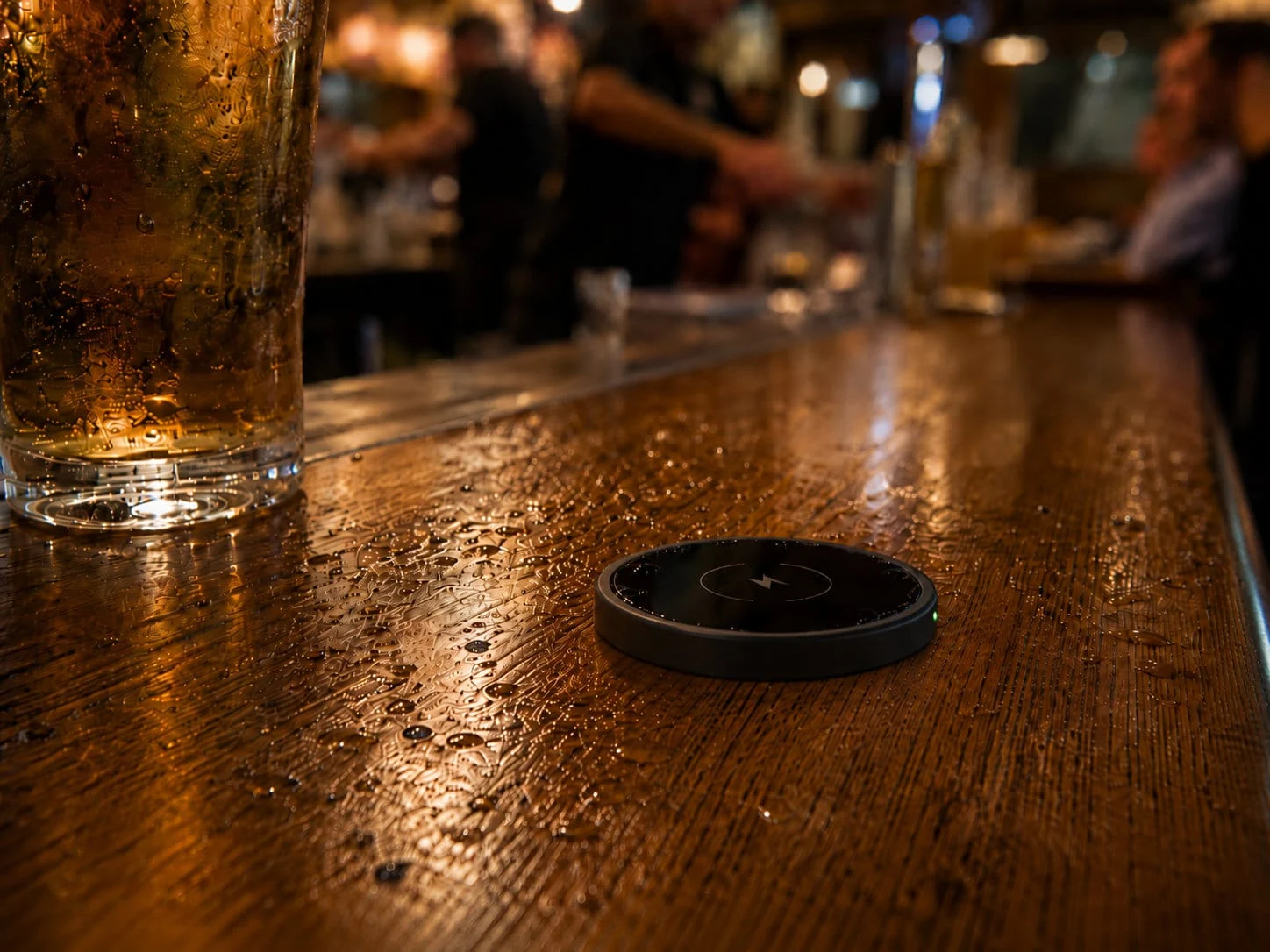
Resources / Licensed venues
Wireless Charging in a Club or Pub Fitout: Plan It In, Place It Right
Dead phones end good nights early. A fit-out is the moment to design that out: ideal charge-point placement, cabling hidden in the joinery, and a compliant unit that keeps liability off your books.
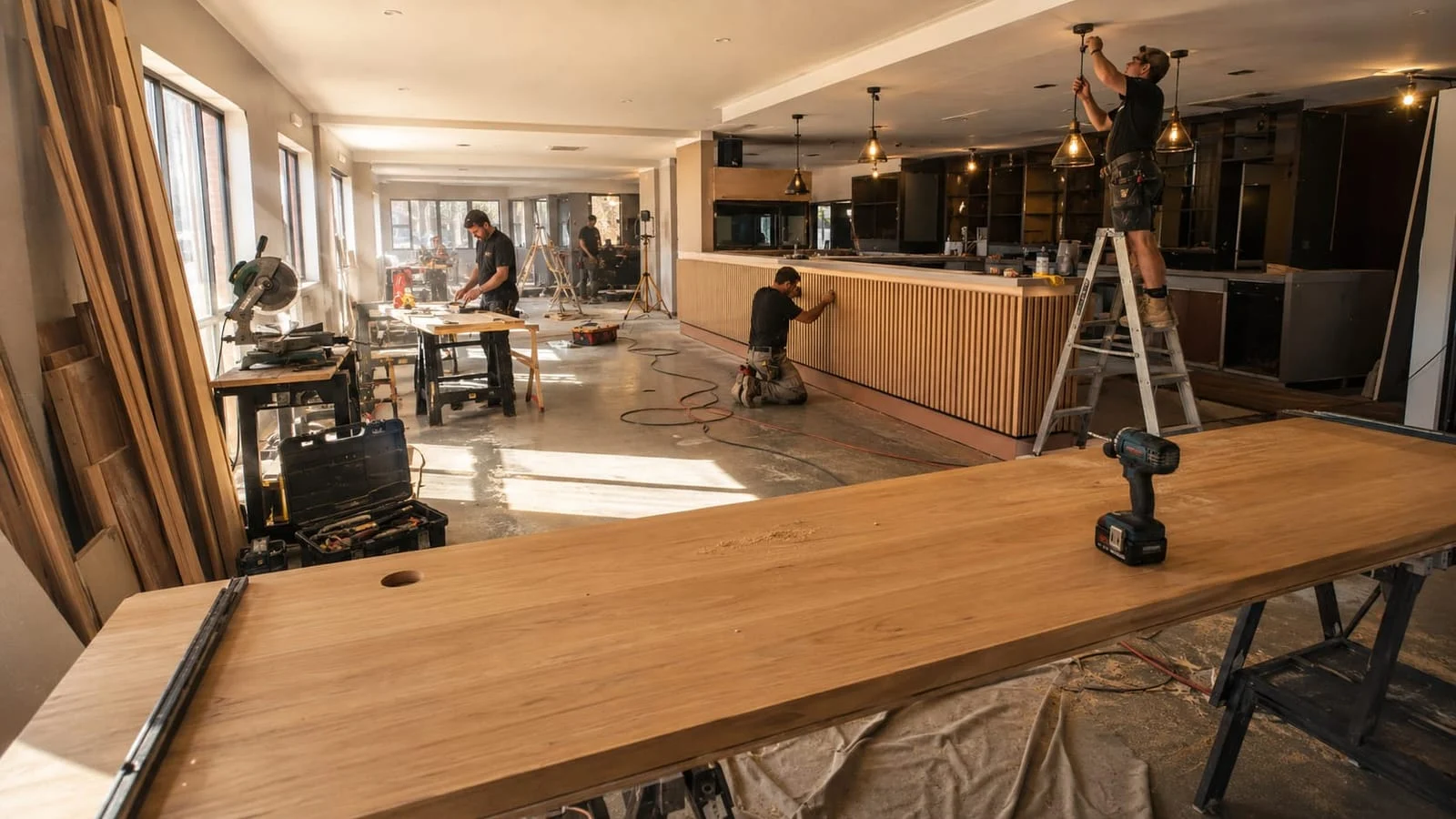
The short version: the units themselves retrofit easily, so you can add wireless charging to a venue at any time. But if a fit-out or refurbishment is already happening, that is the moment to plan it in, because you get to choose exactly where every charge point sits and route the cabling cleanly inside the joinery.
- Retrofit is easy: a single 15mm hole, fastened from below, plugged into a standard power point, no electrician.
- Building it into the fit-out adds two things a retrofit cannot: ideal placement of every charge point, and cabling routed out of sight inside the joinery.
- Two solutions cover the whole venue: one integrated into hobs and surfaces like bars and tables, and a standalone unit that pairs wireless charging with a drink holder for seating that cannot accommodate a traditional hob.
- The spec that matters: 25W, RCM marked and AS/NZS compliant, and a low-profile unit that sits clean on the surface.
- Sourcing a supplied, compliant unit also moves a real liability off the books. Most never think to ask who carries it.
Every club and pub refurbishment makes a hundred small decisions about what gets built in and what gets left to chance. Lighting, screens, data, and power are designed in from the first drawing. Phone charging, almost always, is not. It gets remembered late, solved with a box of pads on the bar, and ends up as the one part of a freshly refurbished room that looks improvised.
The patron notices, even if they could not tell you why. A flat phone is one of the quiet reasons a good night ends early.
15% leave early when they cannot charge. In a 2019 survey of more than 2,000 UK pub and restaurant patrons by Chargifi, 15% said they had left a venue early because they could not charge a dying phone, rising to 20% among those aged 18 to 44. It is UK data, so treat it as directional rather than a local measurement, but the behaviour it describes is universal.
The patron does not ask the bar for a cable. They just manage the battery, stop ordering, and leave to deal with it at home. We have written separately about why some of your best patrons stop coming back without ever complaining. A fit-out is a natural moment to design that problem out of the room, on the surfaces you are already rebuilding, though it is not the only one.
Why build charging into the fitout
You do not have to build it in. The units retrofit easily. A SwiftPro goes into a single 15mm hole, fastens from below, and plugs into a standard power point, fitted in minutes with no electrician, so adding charging to a venue that is not being rebuilt is low-fuss. If a refurbishment is years away, that is no reason to wait.
But when a fit-out or refurbishment is already happening, it is the ideal moment to include charging, for two reasons, both about the finished result.
Placement
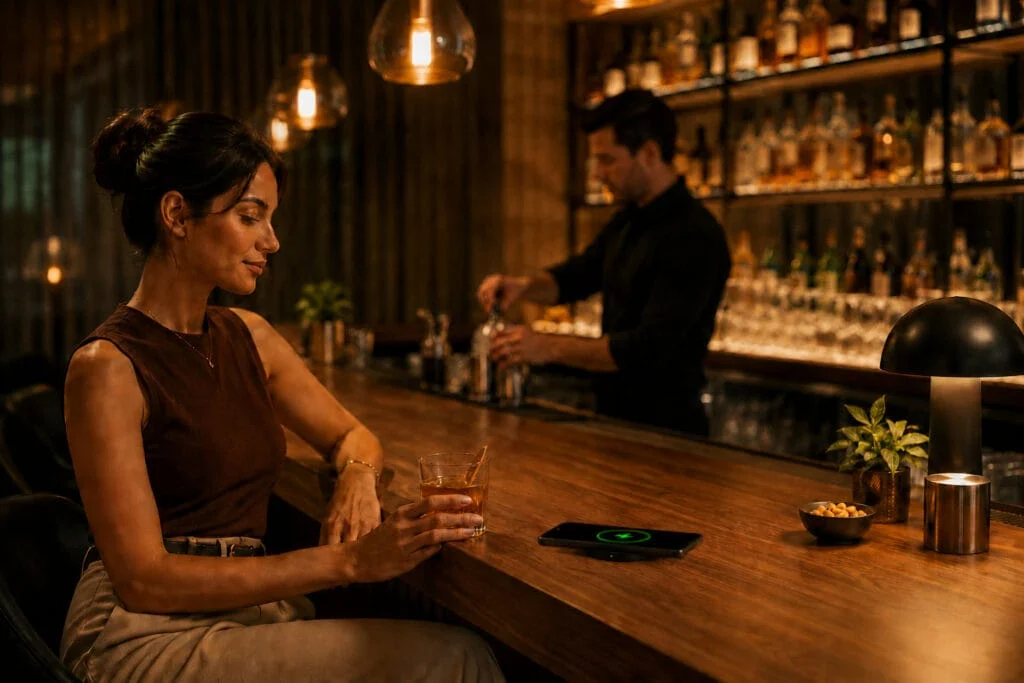
When charging is part of the layout from the start, every charge point goes exactly where patrons actually sit and settle in: the bar rail, the booth tables, the lounge seating. You are choosing the ideal spot as part of the design, rather than fitting a unit wherever it happens to be convenient once the room is finished. Getting the location right is most of what makes charging feel effortless to use.
Cable routing
Because power is already being run to the furniture during the build, the lead from each unit routes back through the joinery to that supply, hidden inside the furniture by design, so there is no cabling trailing across the surface. It was planned in alongside everything else.
Why fit-out partners build it in during manufacturing. When the joinery is being made, the charging is specified, the units supplied, and the points integrated into the surfaces as part of the same build. One scope, one team, no separate trades and no follow-up visit after handover. The charging ends up planned into the room rather than added to it.
Why chargers fail in licensed venues (and what survives)
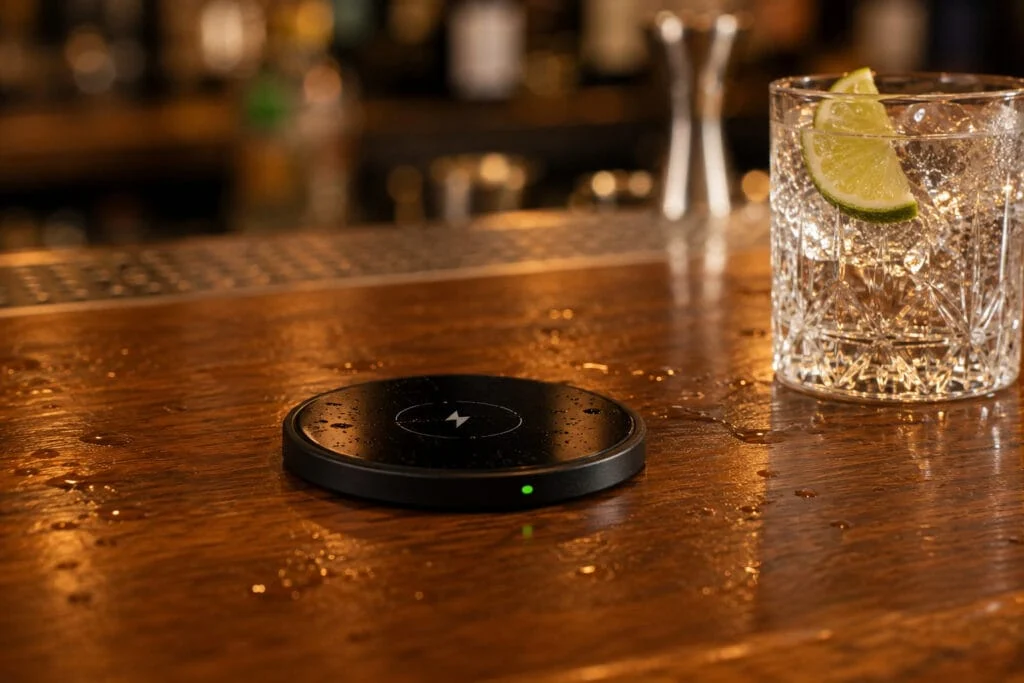
A licensed venue is harder on hardware than an office. There are drinks on every surface, constant turnover, and seating packed far tighter than a workplace. That splits the job into two.
Built-in: SwiftPro 25W, for hobs and surfaces
For bar tops, tables, and booths. The SwiftPro 25W fits through a single 15mm hole and fastens from below with a screw-nut, so there are no visible surface screws and the charging point sits low and clean, about 7.5mm proud of the surface rather than flush.
- Installs through laminate, timber, stone, or composite between 10mm and 50mm thick, covering almost any bar top or table in the building.
- Spill-resistant construction, built for a room where drinks get knocked over.
Standalone: ChargeHUB 25W, for tight seating
For high-density seating that cannot accommodate a hob, where there is no surface to drill into. The ChargeHUB 25W is a standalone unit on a reinforced steel base with an integrated drink holder, purpose-built for the narrow spacing of a club floor.
The drink holder keeps liquid managed and away from nearby equipment, on exactly the kind of floor where spills will happen. No competitor offers a unit built for that spot.
Both deliver 25W Qi 2.2 charging with magnetic alignment, a two-year commercial warranty, and Australian compliance marks. The version of the standard matters, and it is maintained by the Wireless Power Consortium.
Why 25W is the threshold. Older pads run at 5W to 15W and barely move a battery, so a patron stops trusting them. On a phone that supports 25W charging, a current unit takes a device from 20% to 70% in about 33 minutes, fast enough that a patron sees it working in the time they are sitting there.
Our Qi2 charging explainer covers why 25W is the threshold where wireless charging actually changes behaviour.
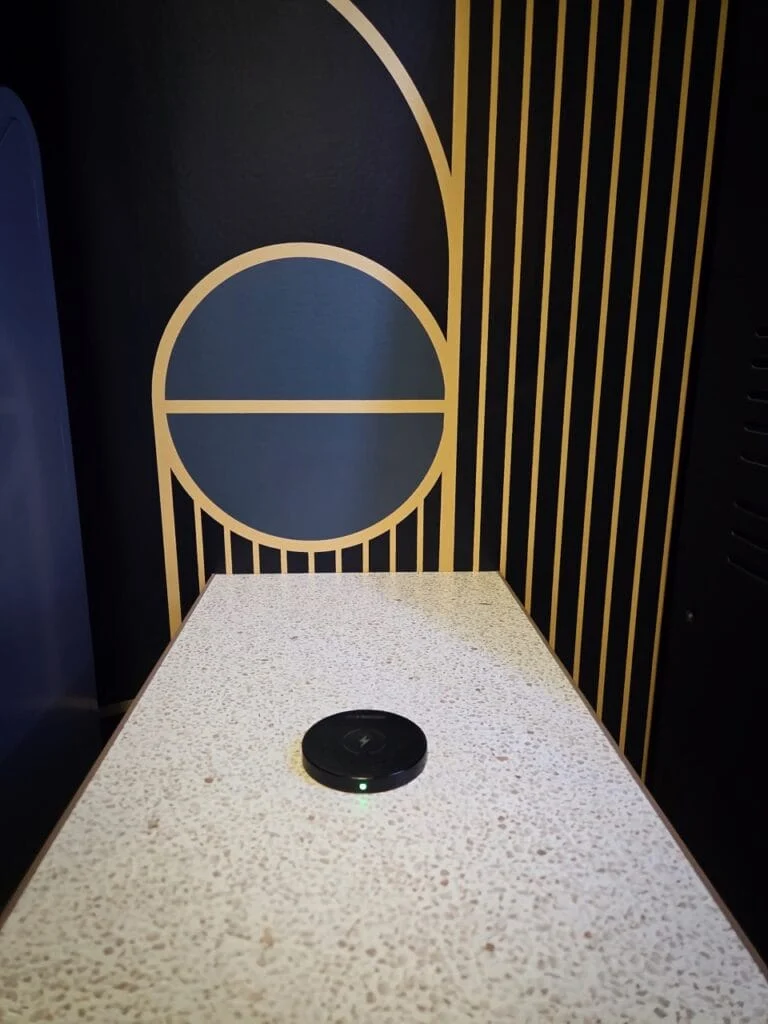
The compliance question every venue and fitout partner should ask
Who is the importer of record? Most venues and fitout firms never think to ask it, and the answer carries real exposure.
A firm that imports its own wireless charging components and installs them into a commercial venue becomes the importer of record for that hardware. That matters:
- RCM marking on a self-sourced import is not automatic. It requires conformance testing the importer has to commission.
- If a unit fails in the field, the liability sits with the party that brought it in and installed it, not the overseas manufacturer.
Under Australia’s electrical equipment safety rules, in-scope gear must not be sold unless it carries the RCM (EESS), and chargers that miss the mandatory standard get recalled. The ACCC has pulled USB power adapters for not complying with it, citing a risk of electric shock (ACCC recall). Most firms doing this have no idea that is the position they are in.
A supplied, compliant unit moves the exposure off your books. Every Stay Charged unit is RCM marked, EMC compliant, and AS/NZS compliant, supplied by an Australian-owned company with Queensland-based support. The compliance and the warranty sit with us, not with the venue or the joiner who fitted it.
For a fitout partner, that is also a way to win and protect work: specifying a supplied, compliant unit turns a standard joinery job into a higher-value, technology-ready one, without taking on the liability of importing hardware they are not set up to certify. It is one of the reasons fitout specialists increasingly prefer to integrate a supplied unit rather than a generic component, and why we back joinery partners with product data, install guidance, and the compliance behind the hardware.
What should be on the spec sheet
Treat charging as a specified component, with the same rigour as power and data. Five requirements decide whether the finished install works.
- Speed. 25W, meeting Qi 2.2 MPP standards, with magnetic alignment. This is the only tier that returns useful charge in the time a patron is actually sitting there.
- Compliance. RCM marked and AS/NZS compliant for the Australian market. A generic import usually cannot demonstrate this, and that is exactly where the liability above comes from.
- Durability. Rated for daily, high-traffic, drink-heavy use, with a commercial warranty. Both Stay Charged units carry a two-year commercial warranty.
- The right unit for the spot. Built-in SwiftPro for hobs and surfaces; standalone ChargeHUB for seating that cannot take a hob. Putting the wrong one in a location is the most common avoidable mistake.
- Clean install. Fitted from below or free-standing, no visible surface screws, nothing a patron can knock off. The SwiftPro needs a single 15mm hole; the ChargeHUB fixes with four screws and a 14mm hole for power. Either takes about five to ten minutes and no electrician, because both plug into a standard power outlet.
Get those five on the drawing and the install behaves predictably. Leave them vague and you inherit whichever cheap pad someone buys to fill the gap, along with the liability that comes with it.
Does it actually earn its place?
Lead with the room, then check the numbers. For the patron, charging that just works is a small, constant signal that the venue was built around them. It removes one of the few causes of an early departure that a venue can remove entirely, and as more of the night runs through a phone, from payments to loyalty apps, a charged phone quietly keeps people in their seats and spending.
A flat phone is increasingly a flat tab. Around 44% of in-person card payments in Australia are now made from a mobile wallet (Reserve Bank of Australia, October 2024). When the phone dies, so does the easiest way for a patron to pay.
The numbers hold up underneath that. For a medium-sized venue:
- A supply-only deployment of around 80 charging points is roughly $8,800.
- On conservative assumptions (about 2% of patrons staying for an extra session), it typically pays back in about 7.7 months.
- After that, there is no commission and no per-use cost.
We deliberately model that on the cautious end. The experience improvement pays for itself and then keeps giving, which makes it an easy line for a board or owner to approve. There is more detail in our comparison of built-in charging versus power-bank rentals, which sets out the difference in ongoing costs.
We have fitted clubs and pubs across Australia since 2017, and built-in charging consistently becomes the part of the room nobody has to think about again.
“Stay Charged is an easy to install device and the customers love it. At first people thought it was a bar coaster but when they learn they can charge their phone they love the idea.”
Mark Warren, Director, Gumeracha Hotel
Stay Charged has supplied commercial wireless charging to more than 300 Australian businesses, with over 15,000 chargers installed, including clubs and venues like Club Blacktown, Mollymook Golf Course, and Ballina RSL. Whether you build it into your next fit-out or add it to the venue you have now, the result is the same: charging that sits where your patrons need it and just works.
Planning a club or pub refurbishment, or specifying for a venue client? Stay Charged supplies commercial wireless charging built for Australian licensed venues, and supports fitout and joinery partners with the right units, compliance, and install guidance. Book a free consultation to scope the right units and placement for your bars, tables, and floor, whether you are planning a fit-out or adding charging to the venue you already have.
Written by Ryan Britz, Director at Stay Charged. Stay Charged has supplied commercial wireless charging to 300+ Australian businesses since 2017, with 15,000+ chargers installed. Australian-owned, Queensland-based, with RCM-marked, AS/NZS-compliant commercial hardware.