Resources / Offices
Hot Desk Wireless Charging: Shared Desks, Coworking, and Multi-Device Demand
On a hot desk with a new occupant daily, loose chargers walk off and cables vanish. Built-in wireless charging belongs to the desk, so it works for whoever sits down.
The short version: hot desk charging only works if it is built into the desk, because on a shared floor nobody owns the desk and nobody brings a charger.
- A hot desk is used by a different person every day, so charging has to belong to the furniture, not the user.
- Loose cables and pads get lost, borrowed, or stolen in a shared environment within weeks.
- One built-in 25W point per seat charges any phone, for any user, with nothing to carry.
- Coworking operators are already treating reliable charging as a membership expectation, not a perk.
The dedicated desk, owned by one person who left their own charger plugged in, is disappearing. Across the Asia-Pacific region, CBRE research points to desk sharing becoming steadily more common, as a growing share of companies move away from a dedicated desk for every employee, and Leesman’s research shows only 39% of people enjoy strictly first-come hot-desking. The desk is increasingly shared equipment rather than personal property.
That single change breaks the way offices have always handled phone charging, which was to assume people sort it out themselves. On a hot-desk floor, they cannot. This is one slice of the broader office wireless charging decision, viewed from the angle that makes it most acute: the desk with a different occupant every day.

The desk nobody owns
When a desk has a different occupant every day, nobody takes responsibility for what is on it. Nobody leaves a charger, because it will not be their desk tomorrow, and nobody reports the cable that went missing, so charging falls straight through the gap.
It also lands on a workforce already dealing with friction. Among Australian workers, more than half feel anxious about finding a desk and nearly a quarter lose up to 30 minutes a day just setting up, with a 2024 La Trobe University review linking hot-desking to lower morale. A dead phone and a hunt for a charger is one more reason the shared floor feels like hard work.
Why does hot desk wireless charging have to be built in?
Because the only thing guaranteed to be at the desk tomorrow is the desk itself. Built-in charging belongs to the furniture, so it serves whoever sits down, in any seat, with nothing to bring and nothing to plug in.
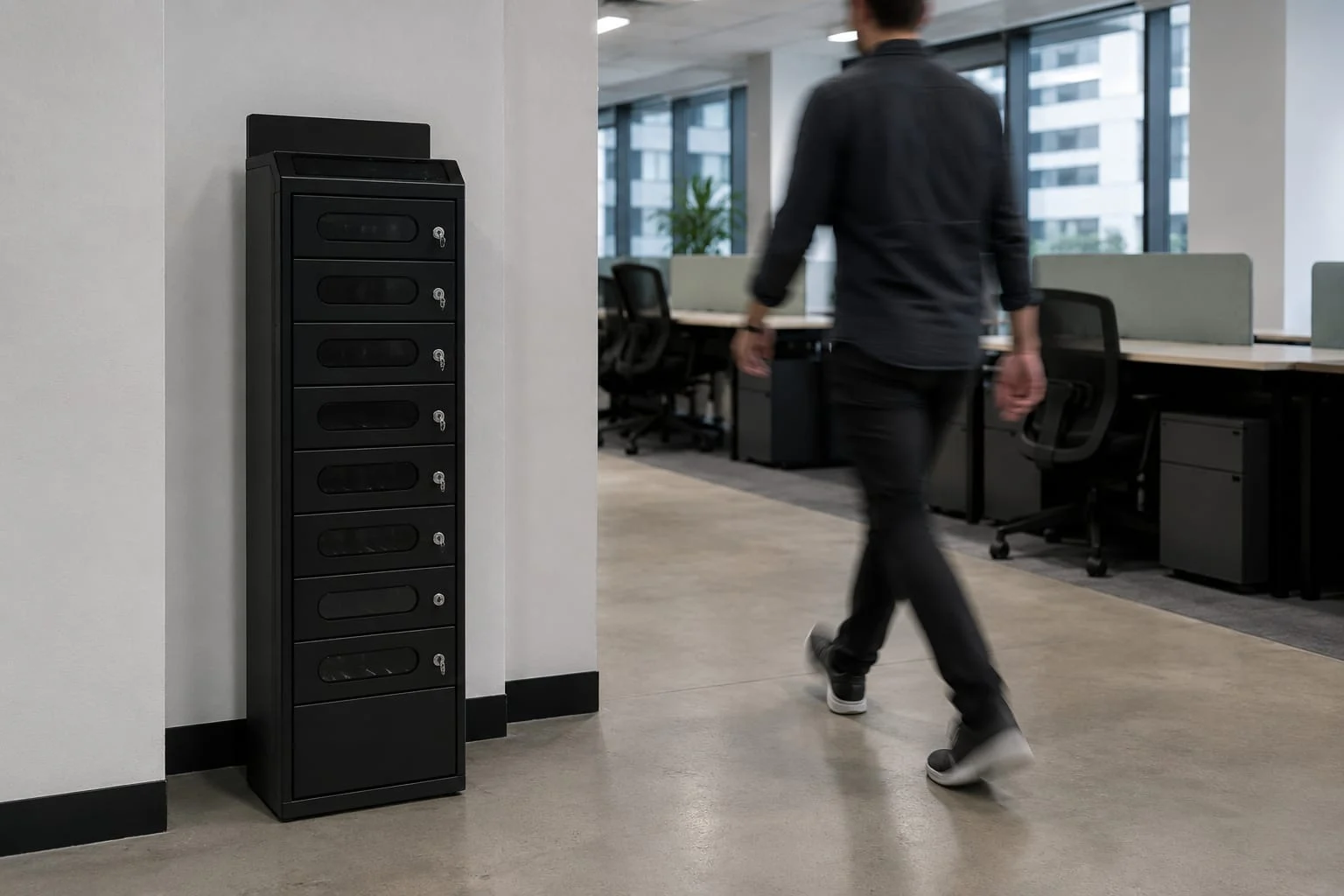
Loose solutions fail the shared test fast. A cable left at a hot desk gets borrowed and not returned, or simply walks off. A pad gets moved to wherever the last person wanted it. Within weeks the floor is back to a scramble for power. A charging point fixed into the desk has nothing to lose or steal. (The same logic is why a communal charging station in the corner tends to go unused: it asks people to leave their seat instead of charging where they sit.)
How does wireless charging survive constant turnover?
It survives only if it is commercial-grade, because the duty cycle is brutal. A hot desk might see a different phone on it every few hours, every working day, for years. A consumer pad rated for one device a night is the wrong tool: the coils drift and the housing fails under that kind of turnover.
Speed matters just as much. A wireless charger works by induction through the desk surface, on the Qi standard maintained by the Wireless Power Consortium. Older pads run at 5W to 15W, which barely moves a battery in the time someone sits at a hot desk. A unit that meets Qi 2.2 MPP standards at 25W, with magnetic alignment, returns enough charge to actually matter, and the Qi2 charging explainer covers why alignment is the part people get wrong.

What does multi-device demand mean for a shared desk?
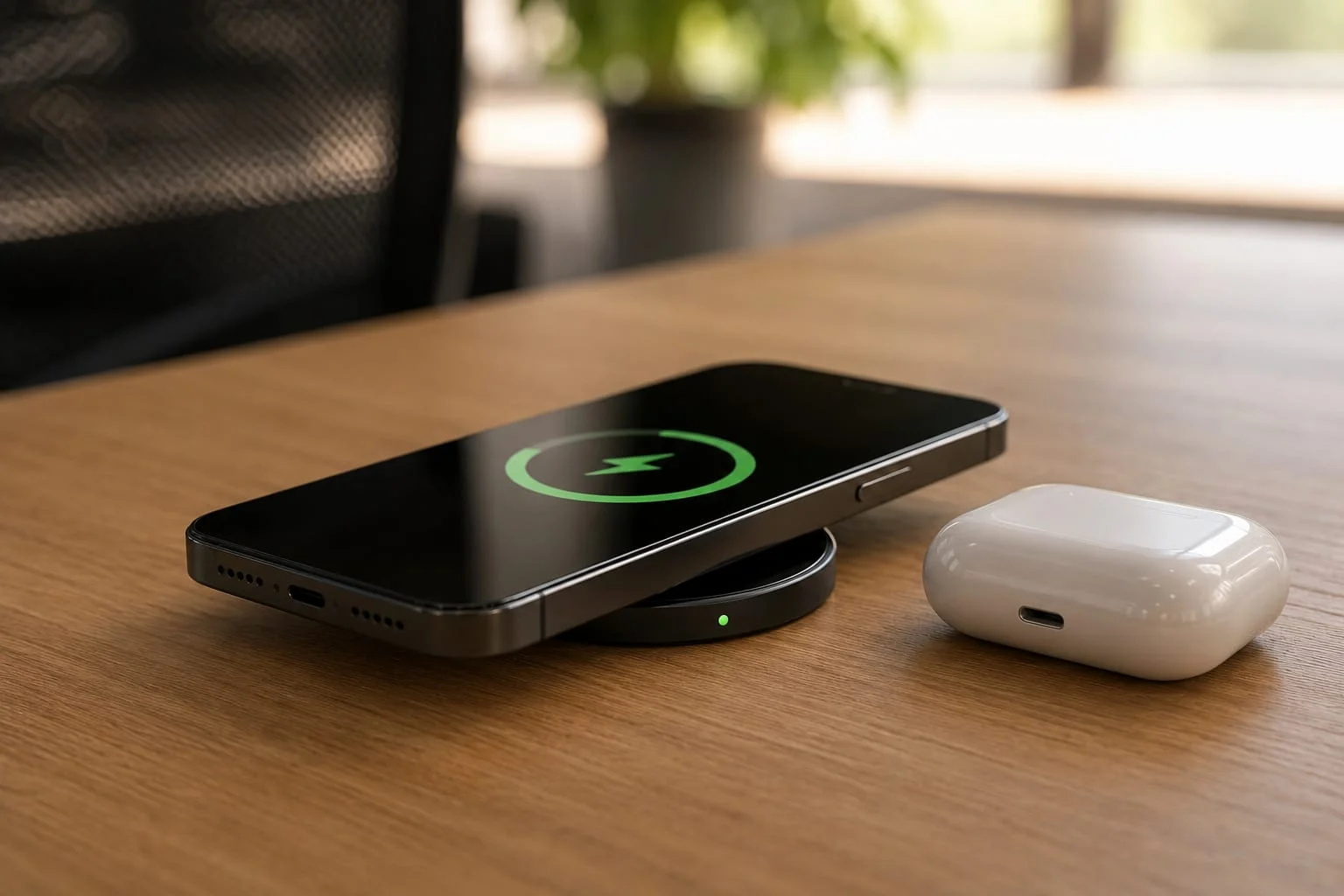
It means one universal point beats a drawer full of cables. People no longer arrive with a single phone. They bring a phone, wireless earbuds, sometimes a watch, often across both Apple and Android. A shared desk has to serve all of it without anyone hunting for the right connector.
A single Qi charging point per seat handles this by being device-agnostic. It does not care whose phone it is or which brand. For a multi-device, mixed-platform workforce, a built-in wireless point at each desk removes the cable drawer entirely and gives every user the same result.
Coworking: when charging becomes a membership expectation
Coworking is the sharpest version of this, because the desk turns over fastest and the operator is selling the experience directly. Australia’s coworking and flexible workspace industry was valued at around AUD $537 million in 2025, nearly double its 2020 size, by Optix’s coworking market figures. In a market growing that fast, members compare spaces, and the small frictions decide who renews.
Reliable charging at every desk is one of those small things that members notice when it is missing. An operator who builds charging into the furniture is making the same bet good venues made on WiFi a decade ago: today a differentiator, soon an expectation.
How should you fit out a hot-desk floor?
Specify charging the way you specify the desks themselves. Four points decide whether it works under shared use:
- Built in, one per seat. Integrated into each desk so it serves any occupant, with nothing loose to lose.
- Speed. 25W, meeting Qi 2.2 MPP standards, with magnetic alignment. Below that, people stop trusting it.
- Certification. RCM marked and AS/NZS compliant for the Australian market.
- Durability. Rated for daily shared commercial use, with a commercial warranty behind it.
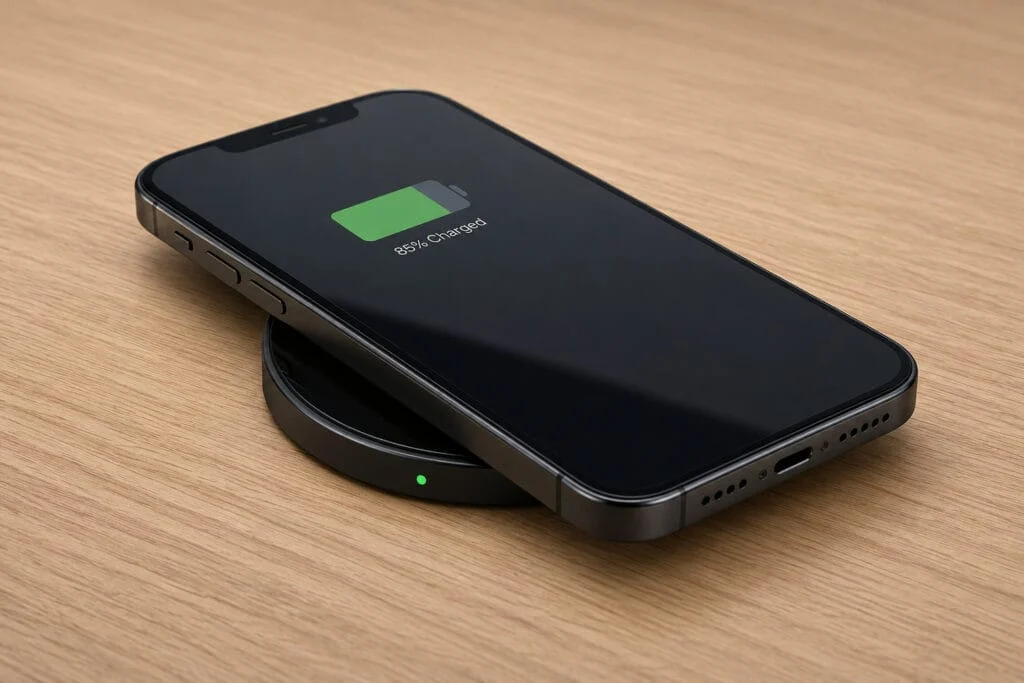
A purpose-built unit like the SwiftPro 25W fits through a single 15mm hole and fastens from below, so the desk surface stays clear and there is no cable to remove later. It charges current iPhones at up to 25W and other Qi devices at up to 15W, and carries a 24-month commercial warranty.
Frequently asked questions
Why is building-owned charging better than letting people bring their own on a shared desk?
A hot desk has a different occupant every day, so nothing personal stays at it. A charger built into the desk belongs to the furniture and serves whoever sits down, with nothing to carry and nothing to plug in. Loose cables and pads in a shared environment get borrowed, moved, or simply walk off within weeks, so only a fixed point survives constant turnover.
Does it work with all phones?
Yes. A single Qi charging point is device-agnostic, so it does not care whose phone it is or which brand. The SwiftPro 25W charges current iPhones at up to 25W and other Qi devices at up to 15W, covering a mixed Apple and Android workforce from one point of use.
How does it install at each desk?
The SwiftPro 25W fits through a single 15mm hole in the desk surface and fastens from below. It sits about 7.5mm proud of the surface, so the desktop stays clear and there is no loose cable to remove later. Once it is in, the cabling disappears under the desk and charging behaves like any other piece of built-in infrastructure.
Which Qi version and speed should I specify?
Specify a unit that meets Qi 2.2 MPP standards at 25W with magnetic alignment. Older pads run at 5W to 15W, which barely moves a battery in the time someone sits at a hot desk. The 25W speed and magnetic alignment are what make the charge fast enough that people actually trust and use it.
Is it durable enough for daily shared use, and is it warranted?
It needs to be commercial-grade, because a hot desk can see a different phone every few hours, every working day, for years. A consumer pad rated for one device a night fails under that duty cycle. The SwiftPro 25W is built for daily shared commercial use, is RCM marked and AS/NZS compliant for the Australian market, and carries a 24-month commercial warranty.
Fitting out hot desks or a coworking floor? Stay Charged supplies commercial wireless charging built for Australian shared workspaces, integrated into the desk so it works for every user. Book a free consultation to scope the right layout for your floor.